

Key takeaways: the surgeon’s cognitive framework
- The surgical plan is held as a strong hypothesis, not a script — the body rarely matches the model exactly.
- Unexpected anatomy is treated as data, prompting a shift from execution mode to diagnostic-and-adaptive mode.
- Decisions draw on two modes: drilled algorithms for known emergencies and heuristic judgment where no algorithm fits.
- Every finding is triaged on three axes: severity, probability, and immediacy.
- The hardest, most important discipline is the strategic retreat — altering or aborting when risk tips against the plan.
- The mind is actively guarded against sunk-cost and anchoring biases.
This essay is about the decisions that begin after the incision. Whether to operate at all — consent, motivation, patient selection, and the integrity of a refusal — is settled beforehand, in the consulting room, and I set that out in my article on the critical decision in plastic surgery.
The illusion of the perfect plan: preparation as a hypothesis
Meticulous preoperative planning is non-negotiable — advanced imaging, 3D modeling, and detailed anatomical forecasting — but I hold this plan not as a script, but as a strong hypothesis. The human body is not a standardized model; it presents anatomical variances, unseen scar tissue from undocumented micro-traumas, and tissue behaviors that no scan can fully predict.
The first critical cognitive skill is the rapid acceptance of this reality without alarm. When I encounter a ligament more robust than anticipated, a blood vessel in an aberrant location, or tissue elasticity that differs from expectation, it is not a complication — it is data. The mind must instantly shift from execution mode to diagnostic-and-adaptive mode, assessing whether the original goal remains achievable via a different route or whether the endpoint itself requires recalibration.
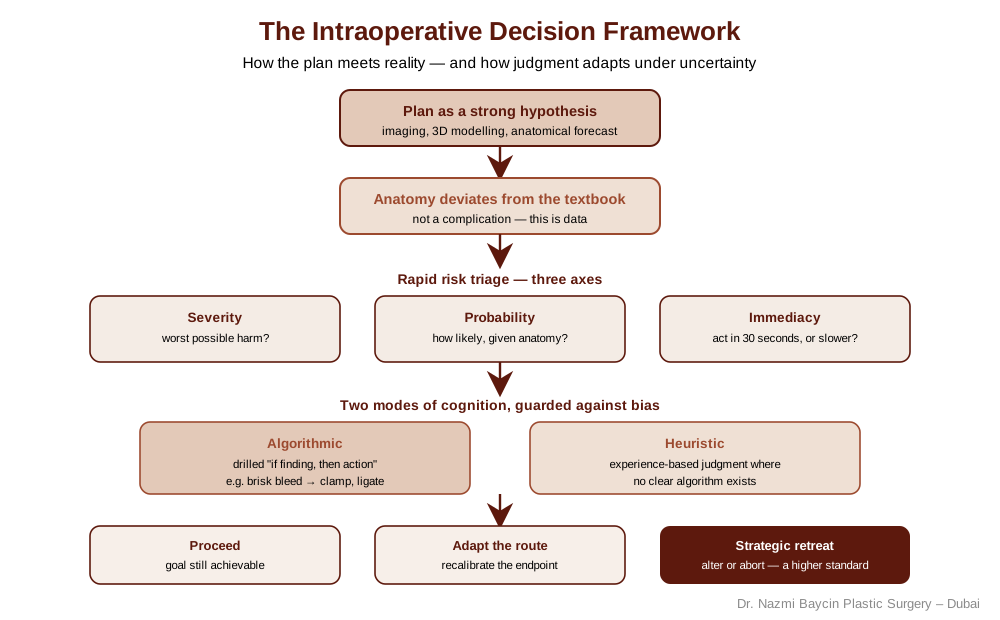
The intraoperative decision framework: the plan is a hypothesis, deviation is data, risk is triaged on three axes, and judgment resolves toward proceeding, adapting, or a strategic retreat — by Dr. Nazmi Baycin, Dubai.
Algorithmic thinking vs. heuristic judgment in real time
Surgical training implants deep-seated algorithms — if this finding, then this action — which are essential for safety and efficiency. Yet complex, unexpected scenarios demand heuristic thinking: experience-based judgment for which no clear algorithm exists. A sudden, brisk hemorrhage from a known vessel mandates an immediate, practiced sequence — suction, pressure, precise clamp application, ligation — the very definition of drill-based cognition.
Encountering severe, unexpected fibrosis during a secondary rhinoplasty that distorts the dorsal support is entirely different: the algorithm may say to proceed with graft placement, but heuristic judgment weighs the quality of the tissue bed, the risk of graft resorption or warping, and long-term stability, and may conclude that the ethical choice is to abort the planned augmentation, reconstruct the L-strut with available septal cartilage, and stage a cautious second procedure. That decision weighs not just technique, but healing biology and patient psychology.
| Dimension | Algorithmic response | Heuristic judgment |
|---|---|---|
| When it applies | Known findings with a practiced, correct answer | Novel or complex findings with no clear rule |
| Basis | Drilled training and protocol | Accumulated experience and pattern recognition |
| Example | Brisk bleed from a known vessel → clamp and ligate | Unexpected fibrosis distorting dorsal support → reassess the whole plan |
| Speed | Immediate, near-reflexive | Deliberate, weighing multiple factors |
| Primary risk | Misapplying a rule to the wrong context | Cognitive bias if not actively checked |
The triad of intraoperative risk assessment
When faced with an unexpected finding, the mind performs a rapid, near-subconscious triage along three axes. Severity asks the worst possible consequence of the finding or a misstep — nerve injury versus transient edema. Probability asks how likely that adverse outcome is, given the specific anatomy and the next move. Immediacy asks whether this demands action in the next thirty seconds, such as major bleeding, or is a slower-burn strategic problem, such as compromised skin-flap viability.
A dense, adhesive scar near the marginal mandibular nerve during a neck lift scores high on all three axes and dictates a stop — dissect under higher magnification and potentially alter the plane of elevation.
A thinner-than-expected subcutaneous fat layer during liposuction is lower on severity and immediacy, allowing strategic adjustment of cannula size and aspiration dynamics to avoid contour irregularity. This constant risk calculus is the silent background process of major surgery.
The philosophy of the strategic retreat: when to stop mid-operation
The most difficult yet most critical decision is to recognize when the risk balance has tipped irreversibly against the planned procedure. Ego and the desire to deliver a promised result exert powerful pressure to push through, and overcoming that requires a separate discipline: the ethics of intraoperative restraint.
My principles are clear — I will alter or abort a plan if patient safety enters a gray zone not adequately covered by consent, if the foundational anatomy cannot reliably support the intended reconstruction (for example, poor-quality rib cartilage for a major dorsal graft), or if proceeding would predictably lead to a substandard or unnatural result even if technically complete. This is not failure; it is a higher standard of care, transforming an operation from a purely technical challenge into a covenant with the patient’s long-term well-being.
Explaining that decision afterwards, with transparency and a more conservative plan, builds profound trust. There is also a quieter version of the strategic retreat that rarely makes headlines: staging. Rather than forcing a complete result through compromised tissue in a single sitting, I will sometimes secure what is safe, allow the body to heal and declare its true biology, and complete the refinement in a planned second stage. Patience, in these moments, is not indecision — it is the deliberate use of time as a surgical tool.
Cognitive debiasing: sunk cost and anchoring in the OR
The surgeon’s mind is vulnerable to cognitive biases, and two are particularly perilous. The sunk-cost fallacy is the inclination to continue on a risky path simply because significant time and effort have already been committed — the thought that two hours have already gone into dissecting this scarred plane, so the implant pocket has to be finished. Against it, I perform regular cognitive resets, asking: if I started this case fresh right now, with what I know, would I choose this same next step?
Anchoring bias is fixating on the initial plan despite contradictory intraoperative evidence; to combat it, I actively seek disconfirming data, pausing to re-evaluate the entire premise when tissue does not respond as anticipated rather than simply applying more force. Ultimately, intraoperative decision-making is a synthesis of science and art — the science of anatomy, wound healing, and outcomes data, and the art of pattern recognition that sees the whole patient and makes a judgment no algorithm can yet replicate.
The mind as the ultimate surgical instrument
The journey through an operation is a continuous dialogue between plan and discovery, between intention and biological reality. The refined hand is useless without the disciplined, agile mind that guides it. For prospective patients and colleagues alike, understanding this internal landscape reveals that the greatest safety feature in a complex procedure is not a piece of technology, but the surgeon’s cultivated ability to think, judge, and ethically adapt under the pressure of the unexpected. A meaningful part of the value in complex or revision surgery lies in exactly this cognitive capital; you can read more of my broader approach to plastic surgery in Dubai. This cognitive readiness is the true foundation upon which surgical trust is built and exceptional results are secured.
FAQs: surgical decision-making under uncertainty
-
Does a surgeon really change the plan during an operation?
Often, yes — and that adaptability is a feature, not a flaw. No scan can fully predict how tissue will behave, so the preoperative plan is treated as a strong hypothesis rather than a fixed script. When the anatomy differs from expectation, a disciplined surgeon reassesses whether the original goal is still achievable by a different route or whether the endpoint needs to be recalibrated.
-
What is the difference between algorithmic and heuristic decisions?
Algorithmic decisions are drilled if-this-then-that responses used for known situations — for example, a brisk bleed from a known vessel triggers an immediate, practiced sequence. Heuristic decisions are experience-based judgments for complex situations where no clear rule applies, weighing tissue quality, healing biology, and long-term stability. Good surgery uses both, in the right moments.
-
How is risk weighed in real time during surgery?
Unexpected findings are triaged along three axes: severity (the worst possible harm), probability (how likely that harm is given the anatomy and next move), and immediacy (whether it demands action within seconds or is a slower strategic problem). A finding that scores high on all three — such as dense scar near a facial nerve — forces an immediate change in approach, while a lower-scoring finding allows for measured adjustment.
-
Why might a surgeon stop or change a procedure partway through?
Because finishing something that cannot be done safely or well is not in the patient’s interest. A plan may be altered or aborted if safety enters a gray zone beyond consent, if the anatomy cannot reliably support the intended reconstruction, or if proceeding would predictably give a substandard result. Choosing restraint in those moments is a higher standard of care, not a failure.
-
What are the biggest mental traps for a surgeon mid-operation?
Two stand out. The sunk-cost fallacy tempts a surgeon to keep going down a risky path because time has already been committed; the antidote is a cognitive reset — asking whether this same next step would be chosen if the case started fresh right now. Anchoring bias is fixating on the original plan despite contradictory evidence; the antidote is actively seeking disconfirming data and re-evaluating the premise.
-
Why does this matter to me as a patient?
Because the greatest safety feature in a complex procedure is not a device but the surgeon’s judgment when something unexpected appears. A surgeon trained to think through a procedure’s potential unraveling — not just to perform its steps — is what protects the outcome when anatomy presents surprises. This cognitive readiness is central to how trust and results are built, especially in complex or revision cases.


GET APPOINTMENT
Get ready to look and feel best… You deserve…
