

Key takeaways: durability is built, not hoped for
- Premature brow drop is usually a technical issue, not just aging.
- The two most common causes are incomplete ligament release and weak fixation.
- Tissue memory means that without a full release the brow pulls back toward its old position.
- Fixation must hold for months, until strong scar tissue forms to take over support.
- Selective depressor-muscle weakening reduces the downward pull that recreates frown lines.
- A mild, natural settling of a few millimeters early on is normal — not true recurrence.
How much elevation actually survives the long term has now been measured. A 2025 systematic review and meta-analysis of endoscopic brow lift stability screened 5,324 articles and pooled the 12 that reported long-term outcomes, finding average retained elevations of 3.25 mm medially, 3.86 mm centrally and 4.35 mm laterally. Two things are worth saying plainly about it. It establishes what a lasting lift looks like in millimeters, which is a useful benchmark — but it does not identify what causes relapse, and its authors close by calling for better long-term data comparing fixation methods, which is precisely the question this article is about. What follows is my reasoning from anatomy and from practice, not a claim that meta-analysis makes.
The anatomical reasons for recurrence: more than gravity
The brow complex is held in place by a dynamic balance of forces. The downward pull comes from strong retaining ligaments — the orbital ligament laterally — and from the action of depressor muscles like the corrugator and procerus. A lift that only addresses the superficial layer without releasing these deep tethers is fighting a losing battle, because the tissue has a memory and a persistent pull toward its original anchored position.
In surgery I identify and meticulously release these restraining structures under direct visualization, which lets the brow move freely into its new position without constant tension. That release is the first and most critical step in ensuring the brow stays where it is placed, and it is a step I never rush in Dubai. Skipping or under-doing it is one of the most frequent reasons an otherwise well-executed lift slowly fails.
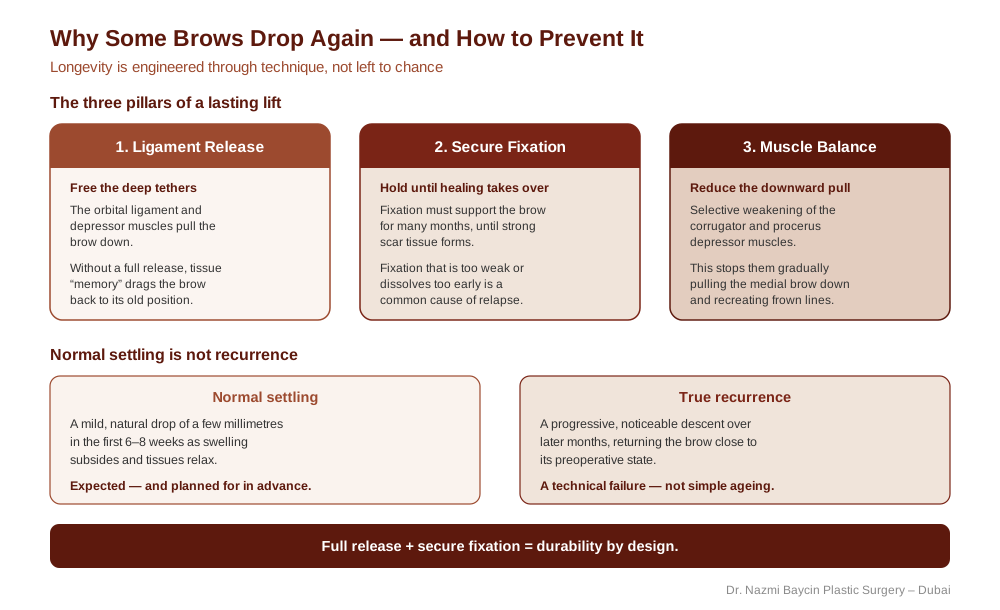
Why some brows drop again — the three pillars of a lasting lift (ligament release, secure fixation, muscle balance) and the difference between normal early settling and true recurrence — by Dr. Nazmi Baycin, Dubai.
The critical role of fixation: a new, stable foundation
Once released, the brow has to be secured, and this is where fixation technique becomes paramount, and where my approach to brow lift surgery in Dubai is most deliberate. I think of it as building a stable foundation while the body’s own healing creates a permanent biological fix.
The method I choose — whether secure suturing to the deep temporal fascia, specialized absorbable fixation devices, or another advanced technique — depends on the individual’s tissue quality, brow thickness, and the degree of lift required. A common technical error is relying on fixation that is either too weak or dissolves before strong, permanent scar tissue has formed to take over the supportive role.
In my hands, fixation is designed to provide robust support for many months, guiding the tissues to heal in the elevated position. Just as important as how firmly the brow is held is the direction in which it is set, because lifting along the wrong vector is what leaves brows looking startled or over-elevated rather than naturally rested. That matters most in patients with thicker, heavier brow tissues or stronger facial musculature, where the forces working against the lift are greatest.
Why technique trumps technology
The endoscopic approach is an option for most patients because it allows for real precision. Through tiny incisions hidden in the hairline, a camera lets me directly visualize and release the ligaments and muscles with an accuracy that open techniques cannot match. But the technology is only as good as the surgeon’s technique.
The key to longevity with an endoscopic lift is the same as with any other: a complete release combined with a secure, well-anchored fixation. When performed with that rigor, the endoscopic brow lifts I carry out in Dubai offer exceptional, natural-looking durability, because they address the problem at its source with minimal disruption. The instrument does not create the result; the surgical judgment behind it does.
The integrated approach: muscle balance and skin quality
A durable lift also requires managing the muscular forces that will act on the brow after surgery. The table below summarizes how each element of the plan protects longevity.
| Element | What It Does | Why It Protects Longevity |
|---|---|---|
| Ligament release | Frees the orbital ligament and deep tethers | Removes the constant downward pull of tissue memory |
| Secure fixation | Holds the brow until scar tissue matures | Prevents early relapse before biological fixation forms |
| Depressor myotomy | Selectively weakens corrugator and procerus | Stops the medial brow being pulled down over time |
| Skin & periorbital plan | Adjuncts or upper blepharoplasty as needed | Ensures the whole region ages harmoniously |
In practice, I routinely perform a selective myotomy — a weakening — of the corrugator and procerus muscles to reduce their depressor action, which prevents them from gradually pulling the medial brow down and recreating frown lines. Judging the degree of that weakening is a careful balance, since the same muscles animate the forehead — it is central to preserving natural, dynamic forehead expression while still protecting the lift. Skin quality cannot be ignored either. In patients with poor skin elasticity, I integrate the brow lift into a broader plan that may include complementary skin-tightening treatments or a tailored upper blepharoplasty, so the entire periorbital area ages harmoniously. A holistic view of the forehead, brows, and eyelids together is what produces a result in Dubai that looks balanced rather than isolated, and that holds its shape as the face continues to change.
Normal settling versus true recurrence
Setting realistic expectations is part of the work. In the first six to eight weeks, as swelling subsides and tissues relax, the brow will experience a mild, natural settling of a few millimeters. That is normal and part of healing, not a failure. True recurrence is different: a progressive, noticeable descent over the following months that returns the brow close to its preoperative state.
My surgical goal is to account for the expected settling in the initial plan, so the final, healed position is precisely where we intended it to be from the start. Understanding this difference also protects patients from unnecessary worry in the early weeks, when a small, expected drop can otherwise be mistaken for the beginning of a relapse.
Durability is a surgical promise, not a hope
A brow lift should be a definitive correction, not a temporary pause. In my practice, longevity is not left to chance — it is engineered through a detailed understanding of forehead anatomy and a commitment to technical precision. By fully releasing the restraining forces and providing stable, lasting fixation, I create results built to withstand time and gravity.
That engineering-first mindset is what you should expect from a leading plastic surgeon in Dubai: a surgeon who can articulate not just what they will do, but how and why their specific techniques produce a result you can enjoy for a decade or more. Because every forehead and brow is different, the right combination of release, fixation, and muscle management — and its cost — is best determined at a consultation built around your individual anatomy.
FAQs about brow lift longevity in Dubai
-
Why do some brows drop again after a brow lift?
Premature brow drop is usually a technical issue rather than simple aging. The two most common causes are an incomplete release of the deep tissues that pull the brow down, and a fixation method that is too weak or dissolves before strong scar tissue has formed to take over support. If the retaining ligaments are not fully released, the tissue’s natural memory keeps pulling the brow back toward its original position. A lift engineered with a complete release and secure, long-lasting fixation is far more resistant to this kind of relapse.
-
What is the difference between settling and true recurrence?
Settling is a mild, natural drop of a few millimeters in the first six to eight weeks, as swelling subsides and the tissues relax. It is completely normal and is planned for in advance, so the final healed position ends up exactly where intended. True recurrence is different: a progressive, noticeable descent over the following months that brings the brow back close to its preoperative state. Settling is part of healing; recurrence reflects a technical shortfall in the original surgery, usually in release or fixation.
-
Why is ligament release so important for longevity?
The brow is held down by strong retaining ligaments and by depressor muscles. If a lift only elevates the superficial layer without releasing these deep tethers, it is working against a constant downward pull, and the tissue’s memory gradually drags the brow back. Releasing these structures under direct visualization allows the brow to sit in its new position without ongoing tension. This is the single most critical step in preventing relapse, because no fixation can indefinitely hold a brow that is still being actively pulled downward.
-
How does fixation technique affect how long results last?
Fixation holds the brow in its elevated position during the months it takes for the body to form strong scar tissue that provides permanent, biological support. If the fixation is too weak, or dissolves before that scar tissue matures, the brow can descend before the natural fix has taken over — a frequent cause of early relapse. The specific method is chosen for each patient based on tissue quality, brow thickness, and the degree of lift, and it is designed to give robust support for as long as healing requires.
-
Is an endoscopic brow lift more durable than other techniques?
The endoscopic approach allows excellent precision, using a camera through small hairline incisions to release the ligaments and muscles accurately with minimal disruption. However, durability depends on how the technique is executed, not the instrument itself. An endoscopic lift lasts when it combines a complete release with a secure, well-anchored fixation; done without that rigor, it can relapse just as any method can. In the right hands, the precision of the endoscopic method supports very natural, long-lasting results.
-
How long should a well-performed brow lift last?
A brow lift that is properly engineered — with full ligament release, secure fixation, and appropriate muscle management — is intended to be a lasting correction rather than a temporary pause, with results many patients enjoy for a decade or more. The brow will still age gradually along with the rest of the face, since surgery cannot stop the aging process. What good technique prevents is the early, disproportionate relapse that occurs when the underlying forces are not properly addressed. Realistic planning accounts for natural aging while protecting against premature drop.
-
Can weakening the frown muscles prevent the brow from dropping again?
Selectively weakening the corrugator and procerus muscles is an important part of a durable result. These depressor muscles actively pull the medial brow downward and deepen frown lines, so reducing their action removes one of the forces that works against the lift over time. It is not a standalone solution — it works alongside proper release and fixation — but addressing muscle balance helps prevent the gradual medial descent and returning frown lines that can otherwise undermine an initially good outcome. The degree of weakening is judged individually to keep expression natural.


GET APPOINTMENT
Get ready to look and feel best… You deserve…
