

Key takeaways: structure before reduction
- Lasting rhinoplasty is built on preserving and reinforcing the nasal framework, not aggressive reduction.
- The philosophy rests on three pillars: structural preservation, individualized aesthetics, and function.
- Over-resection of the lower lateral cartilages weakens the tip and alar rims, causing pinching and breathing problems.
- The middle vault must be preserved or reconstructed — often with spreader grafts — to protect the airway and dorsal line.
- Autologous cartilage or bone (from septum or ear) provides living, integrated support rather than rigid implants.
- Function is non-negotiable: a beautiful nose that cannot breathe freely is a surgical failure.
Understanding the individual anatomical canvas
True mastery in rhinoplasty begins with respect for the individual anatomical canvas. The nose is a complex, three-dimensional structure of skin, cartilage, and bone — not a simple sculpture to be carved in isolation — and in Dubai’s diverse population this assessment is especially critical, as nasal characteristics and skin types vary immensely.
I analyze each patient’s anatomy as an integrated system, where enhancing one element must not destabilize another. A frequent technical error I meticulously avoid is over-resection of the lower lateral cartilages, which can weaken the nasal tip and alar rims, leading to pinched contours and breathing difficulties.
My methodology favors conservative refinement, often employing precise suture techniques and strategic cartilage grafting to support and enhance the natural architecture, so the final result is refined, structurally sound, and physiologically robust.
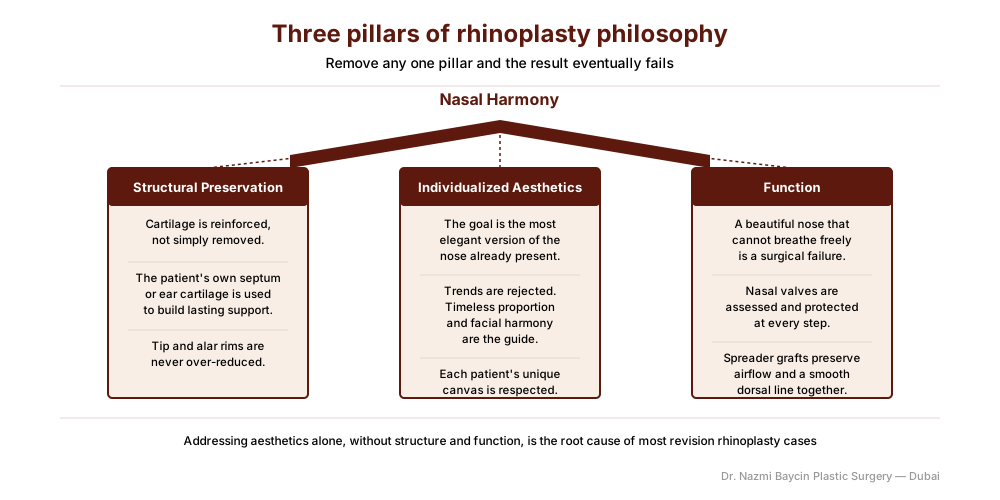
The three pillars of a structure-first rhinoplasty philosophy — structural preservation, individualized aesthetics, and uncompromised function — by Dr. Nazmi Baycin, Dubai.
The guiding surgical philosophy: harmony over conformity
The surgeon’s philosophy is the invisible hand that guides every decision and incision, and mine is built upon three unwavering pillars: structural preservation, individualized aesthetics, and the paramount importance of function.
I approach rhinoplasty as architectural refinement, carefully revealing the most elegant version of the nose that already exists within its own framework — which often means using the patient’s own cartilage, harvested from the septum or ear, to provide subtle, living support rather than aggressively removing tissue. This autologous tissue becomes a permanent, integrated part of the nose, a cornerstone of lasting quality.
The trend toward aggressive reduction seeks a uniform look, often at the expense of character and function; my practice stands in contrast, seeking a balance that reflects the patient’s identity.
| Pillar | What it means | How it is achieved |
|---|---|---|
| Structural preservation | Reinforce the framework rather than reduce it | Preserve cartilage; support the middle vault; avoid over-resection |
| Individualized aesthetics | Proportions tailored to the individual, not to trends | Whole-face analysis; conservative, identity-preserving refinement |
| Function | Effortless breathing as a non-negotiable outcome | Protect the nasal valves; correct septum; reinforce with grafts |
Technical mastery and the avoidance of common pitfalls
While philosophy provides the map, technical mastery is the journey itself, and the open rhinoplasty approach offers the visualization necessary for millimeter-precise work on delicate structures.
A critical nuance lies in managing the middle vault — the area where the nasal bones meet the upper cartilages — where over-reduction is a long-recognized pitfall that can leave a visible inverted-V deformity and an unsupported internal nasal valve. Spreader grafts are the standard response, and their place in reconstructing a compromised dorsum is set out explicitly in a published decision algorithm from a series of eighteen revision rhinoplasty patients, which assigns spreader grafts to an S-shaped cartilaginous dorsum and to the absence of dorsal aesthetic lines. That series measured aesthetic satisfaction rather than airflow, so it maps the decision rather than proving the functional consequence. I therefore preserve or meticulously reconstruct this area, frequently using spreader grafts, to maintain both a smooth dorsal line and a patent airway.
Where the dorsum itself has been over-resected or left irregular, autologous bone and cartilage can rebuild it: in work I co-authored on an anatomically adopted dorsal graft, bone chips and diced cartilage were used to reconstruct the nasal dorsum and smooth dorsal irregularities, reconstructing the bony side of the nose with bone and the cartilage side with cartilage.
Nasal tip refinement is likewise an art of balance: I employ suturing techniques that create stable, defined, naturally cohesive contours, avoiding rigid artificial implants that can shift or become visible over time.
The inseparable link: beauty and function
A nose that is beautiful but cannot breathe freely represents a fundamental surgical failure. In my practice, functional integrity is the non-negotiable bedrock upon which all aesthetic ideals are built. During every step I assess and protect the intricate nasal valves — the dynamic structures that regulate airflow — and correcting a deviated septum or reinforcing weak valves with carefully placed grafts is not a separate task but an integral part of sculpting a harmonious nasal form.
This dual-purpose methodology ensures that every aesthetic improvement also contributes to optimal respiratory health, resulting in a nose that is as healthy as it is elegant. Healing then becomes a partnership in patience: while initial swelling diminishes noticeably within the first few weeks, the final, refined result reveals itself gradually over about twelve months as the tissues soften and settle, and diligent adherence to a personalized post-operative protocol is the final component in protecting the result.
Why the skin envelope shapes the plan
One factor decides how a nose will heal more than almost any other, and it is often overlooked in the rush to reshape the underlying framework: the skin envelope. In Dubai I operate on an unusually wide range of skin types, and each behaves differently.
Thin skin drapes tightly over the new structure and reveals every detail — which is unforgiving of any irregularity, but rewards refined work with crisp definition.
Thick, sebaceous skin, by contrast, resists redraping, holds swelling far longer, and tends to blunt fine tip definition unless the underlying scaffold is made strong and projecting enough to push back against it.
This is precisely why a structure-first philosophy matters across the whole spectrum of patients. With thin skin, preserved and smoothly contoured cartilage prevents visible edges; with thick skin, a robust, well-supported framework is the only way to achieve definition that the skin will actually show. In both cases, reducing structure rather than shaping it works against the skin instead of with it.
Primary versus revision: why the principle holds either way
The preservation philosophy is easiest to honor in a primary rhinoplasty, where the anatomy is untouched and every structure can be kept, reshaped, and reinforced rather than removed. It becomes even more important in revision cases, which make up a large share of the noses I see. By the time a patient reaches a revision, structure has usually been lost and scar tissue has replaced healthy planes.
Revision surgery is therefore reconstructive as much as aesthetic, and it punishes any lingering instinct to reduce. The goal shifts to rebuilding what was taken away: restoring dorsal height, re-supporting a collapsed middle vault, and re-establishing tip support so the nose can hold its shape for the long term. Which donor tissue that rebuilding calls for, and in what order, is a subject in its own right and one I treat separately. The principle does not change between a first and a second operation; the second simply proves why the principle was right all along.
Choosing your surgeon
Ultimately, your choice of surgeon is the single most decisive factor in your rhinoplasty journey. I encourage you to look beyond before-and-after galleries and seek evidence of a consistent, logical surgical philosophy — examining a surgeon’s published writings on technique, ethics, and their fundamental approach to the nose.
In a vibrant market like Dubai you will find many technical practitioners, but the more meaningful search is for a philosophical artist whose principles you can study. Because complexity varies from a primary case to a demanding revision that requires intricate reconstruction of previously altered anatomy, the plan is always individualized to your anatomy; the full details of my structure-first approach are set out on my main rhinoplasty in Dubai page.
FAQs about a philosophical approach to rhinoplasty in Dubai
-
Why do you emphasize preserving structure rather than reducing the nose?
Because aggressive reduction is the most common cause of the problems I see in revision patients: a weakened tip, collapsed middle vault, pinched contours, and compromised breathing. Removing structure may look appealing on the operating table, but over months and years the nose can lose support and distort. Preserving and reinforcing the framework — often with the patient’s own cartilage — builds a result that stays stable and breathes well for decades.
-
What is the middle vault, and why does it matter so much?
The middle vault is the region where the nasal bones meet the upper cartilages, and it houses the internal nasal valve — the narrowest part of the airway. Over-reducing it during hump removal is a classic pitfall that can produce a visible inverted-V deformity and valve collapse, impairing breathing. I preserve or reconstruct this area, frequently with spreader grafts, to protect both the dorsal line and the airway.
-
Why do you prefer the patient’s own cartilage over implants?
Autologous tissue — cartilage from the septum or ear, or bone chips for the dorsum — becomes a living, integrated part of the nose. It supports the framework naturally and resists the shifting, visibility, and long-term complications that rigid artificial implants can cause. In my experience, this is the foundation of a durable, natural-looking result.
-
Can rhinoplasty improve my breathing as well as my appearance?
Yes, and in my philosophy the two are inseparable. A beautiful nose that cannot breathe freely is a surgical failure. During every procedure I assess and protect the nasal valves and, where needed, correct a deviated septum or reinforce weak valves with grafts — so that each aesthetic improvement also contributes to better respiratory function.
-
How long does it take to see the final result?
The most noticeable swelling settles within the first few weeks, but the final, refined result reveals itself gradually over about twelve months as the tissues soften and settle. This is why patience and adherence to your personalized aftercare protocol matter so much — the outcome matures over time rather than appearing all at once.
-
What should I look for when choosing a rhinoplasty surgeon?
Look beyond before-and-after photos for evidence of a consistent, logical surgical philosophy. Examine the surgeon’s published writings on technique and their fundamental approach to the nose, and seek someone who prioritizes structural preservation and function rather than trend-driven reduction. The right surgeon is a philosophical artist whose principles you can actually study.


GET APPOINTMENT
Get ready to look and feel best… You deserve…
