

Key takeaways: vaginoplasty after multiple deliveries
- Repeated vaginal deliveries permanently overstretch the pelvic floor — the fascia thins, the vaginal walls weaken, and the levator muscles separate.
- Grand multiparity (five or more deliveries) is a distinct surgical category where standard back-wall tightening repairs frequently fail.
- Durable correction requires addressing three structures together: the fascia, the levator muscles, and the perineal body.
- The standard four-stage sequence is adapted, not replaced — hydrodissection and site-specific fascial repair are added ahead of it for fragile tissue.
- The perineum is the most overlooked structure; without rebuilding it, the opening stays gaping no matter how tight the mid-vagina is.
- Suture choice follows the layer — permanent in the muscle and pelvic floor, dissolvable in the lining; the repair takes 90–120 minutes.
The cumulative damage of repeated vaginal deliveries
The pelvic floor is not designed for unlimited stretching. During a vaginal delivery, the levator ani muscles stretch to up to three times their resting length — an extreme biomechanical event. After a single delivery, the muscles and fascia often recover partially, but with repeated deliveries the elastic fibers become permanently overstretched. The connective tissue loses its tensile strength, the vaginal walls thin, and the rectovaginal fascia becomes lax.
A retrospective study of 324 women attending a tertiary urogynecology clinic found that 24% of them reported vaginal laxity, and that on univariate analysis the symptom was associated with vaginal parity — the number of vaginal deliveries — as well as with younger age and with the symptoms and findings of prolapse. Its strongest associations were with the genital hiatus plus perineal body measurement and with levator hiatal area on the Valsalva maneuver, which led the authors to conclude that vaginal laxity is a manifestation of levator ani hyperdistensibility; in other words, the muscles have lost their ability to maintain normal tension.
This is the tissue reality I face when a multiparous patient sits in my consultation room. The vagina is not just slightly loose; it is globally lax, often from the apex to the introitus. The tissues are thin, fragile, and poorly vascularized, and standard techniques that work well for a woman with one or two deliveries often fail here.
The grand multipara: a distinct surgical category
Grand multiparity — defined as five or more deliveries — represents a special surgical challenge, and I have operated on women with seven, eight, or even ten vaginal births. In these cases, the pelvic floor is not just stretched; it is structurally compromised. The levator ani muscles are often widely separated, and the rectovaginal fascia is attenuated, sometimes to the point of being translucent.
The perineal body may be paper-thin or completely absent, and scar tissue from episiotomies or previous repairs further complicates the anatomy. Blood supply to the vaginal mucosa is often reduced, which increases the risk of wound healing complications. A standard posterior colporrhaphy — tightening only the back wall with a few running sutures — is simply inadequate for this patient population. The tissues will not hold the sutures, and the repair will fail, often within months. I have seen this pattern repeatedly in women who come to me for revision surgery after being disappointed elsewhere.
The failure of one-size-fits-all techniques
Many surgeons approach every vaginoplasty the same way: they make a midline incision in the posterior vaginal wall, dissect the rectovaginal fascia, place a few plicating sutures, and close. This works acceptably for mild to moderate laxity in younger, low-parity patients, but it fails catastrophically for the grand multipara. The reasons are straightforward:
- First, the fascia in a grand multipara is not simply loose; it is thin and fragile, so sutures placed through thin fascia tear through and the plication loosens over time.
- Second, the levator ani muscles are widely separated, and a standard posterior colporrhaphy does not reapproximate these muscles. The hiatal gap remains large, and the vagina cannot narrow sufficiently.
- Third, the perineal body is often deficient; without rebuilding the perineum, the vaginal opening remains gaping even if the mid-vagina tightens.
A retrospective series of 45 patients in Plastic and Reconstructive Surgery is the most directly relevant published support for a more comprehensive approach. It evaluated transvaginal posterior levatorplasty combined with perineoplasty in women treated between 2020 and 2022, and reported significant improvement in vaginal laxity scores and in female sexual function measured by the Female Sexual Function Index, which rose from 21.68 before surgery to 26.88 at six months and 29.97 at twelve months. Symptoms of stress urinary incontinence and of recurrent vaginitis improved in 78.6% and 90.5% of patients respectively.
The authors concluded that this combined procedure is effective for improving patient symptoms, quality of life, sexual function, stress urinary incontinence, and postnatal constipation. It is a single-centre retrospective study with no control group — level IV therapeutic evidence — so it establishes that the combined procedure performs well, not that it outperforms a simpler repair. It nonetheless confirms what I have observed in my own practice: a superficial repair is not enough. You must address the levator muscles, the fascia, and the perineum together.
My layered repair protocol for the severely stretched vagina
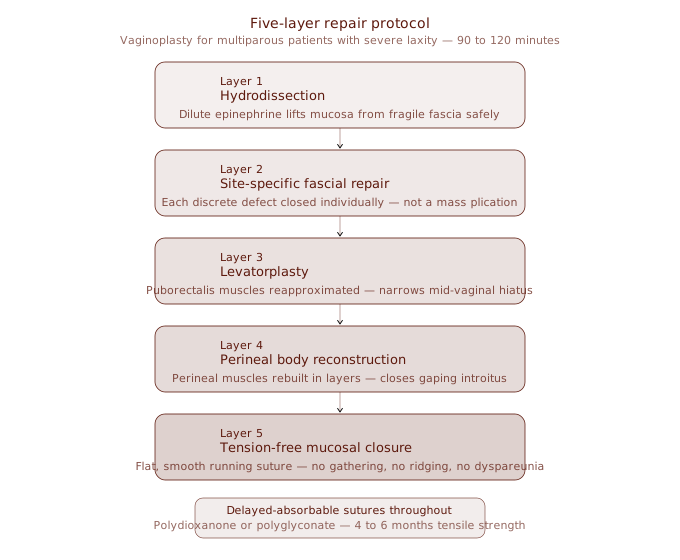
The five-layer repair protocol for the severely stretched vagina after multiple deliveries — by Dr. Nazmi Baycin, Dubai.
This is not a different operation from the one I perform routinely. It is the four-stage protocol I set out for a high-accuracy repair, adapted for fragile tissue: hydrodissection and a site-specific fascial repair are added ahead of the levator ani and perineal stages, and the mucosal refinement at the end is the same conservative step. When I operate on a patient with multiple prior vaginal deliveries, I do not take shortcuts. This layered repair takes time; I spend 90 to 120 minutes in the operating room, compared with the 45 to 60 minutes reported for standard vaginoplasty. But the results are durable, and my revision rate for grand multipara patients is under five percent.
| Layer | What I do | Why it matters |
|---|---|---|
| 1. Hydrodissection | Inject dilute epinephrine solution into the submucosal plane | Lifts the mucosa off the fascia, reduces bleeding, and prevents buttonholing of thin, fragile tissue |
| 2. Site-specific fascial repair | Inspect the rectovaginal fascia and close each discrete defect individually with interrupted sutures | Repairs only what is damaged while preserving healthy tissue — stronger than a single midline mass plication |
| 3. Levatorplasty | Reapproximate the separated puborectalis muscles with two to three interrupted permanent sutures | Narrows the mid-vagina and restores functional pelvic floor support where muscles are 2–3 cm apart |
| 4. Perineal body reconstruction | Mobilize and suture the perineal muscles in layers to rebuild a supportive platform | Anchors the posterior wall and prevents a gaping introitus — the most overlooked step |
| 5. Tension-free mucosal closure | Close with running 3-0 or 4-0 dissolvable suture, flat and smooth | Avoids ridges, pleating, and dyspareunia |
Why the layer dictates suture choice
Suture selection is not a single decision but one made layer by layer, and the principle is the same in every vaginoplasty I perform: permanent sutures in the levator ani and the pelvic floor, dissolvable sutures in the vaginal mucosa and submucosa.
The reason is that the two layers are being asked to do different things. The muscular repair has to hold indefinitely against the loads that stretched it in the first place, and in a grand multipara that tissue is thinner, less vascular, and slower to lay down new collagen than in a low-parity patient. A permanent suture in the muscle keeps the reapproximation while the tissue consolidates and does not surrender it afterwards. The lining, by contrast, only has to stay closed while it heals, and it heals quickly — so a fine dissolvable suture is the right choice there, and a permanent one at the surface would risk erosion and discomfort for no benefit. I also use interrupted rather than running sutures in the deep layers: if one interrupted suture fails, the others hold, whereas if a running suture fails, the entire repair can unravel.
The perineum: the most overlooked structure in vaginoplasty
I have seen countless vaginoplasty patients who remained dissatisfied because their perineum was never addressed. The perineum is the foundation of the vaginal opening, and if it is weak or absent, the vagina will feel open no matter how tight the mid-vagina is. The grand multipara patient almost always has a deficient perineal body because the muscles have been torn, stretched, or scarred beyond function.
Rebuilding the perineum requires a perineoplasty performed simultaneously with the vaginoplasty: I bring the separated perineal muscles together in layers and close the perineal skin with a fine absorbable suture, often using a V-Y advancement to add length. Why the perineal body matters as much as it does, and what it actually is, I set out in my article on the perineal body as the keystone of the vaginal opening.
The 45-patient series cited earlier specifically evaluated levatorplasty combined with perineoplasty, and its outcomes are the closest published support for this combined approach in patients with severe laxity, which almost always includes a perineal component. To see how I assess the severity of laxity during your consultation, follow this link to vaginoplasty in Dubai.
Respect the tissue, respect the history
A woman who has given birth multiple times has a surgical history written into her pelvic floor. Her tissues have endured years of stretching, tearing, and incomplete healing, and a superficial, rushed vaginoplasty disrespects that history — it will fail.
My philosophy is different: I examine each layer, repair each defect individually, rebuild the perineum, and choose sutures that match what each layer has to do. The result is a vagina that feels tight, functions well, and stays that way. This is not a matter of preference but of physics: sutures placed in tissue that cannot hold them will loosen, and a repair that ignores the levator muscles and the perineum leaves the true cause of laxity untouched.
Matching the operation to the anatomy in front of me is the difference between a result that lasts and one that disappoints within months. A layered vaginoplasty with levatorplasty and perineoplasty is a significantly more complex undertaking than a standard posterior repair — it involves careful suture selection, advanced dissection, and a longer follow-up period to monitor healing in fragile tissues.
If you are a multiparous woman who has been told that nothing can be done for your laxity, or if you have had a previous vaginoplasty that failed, I invite you to schedule a consultation with me as an experienced cosmetic surgeon in Dubai. Your history deserves respect, and your repair deserves the same.
FAQs about vaginoplasty after multiple deliveries in Dubai
-
Does vaginoplasty work after multiple deliveries?
Yes — but only when the technique is adapted to the severity of the tissue damage. After multiple deliveries the vagina is often globally lax, with thin fascia, separated levator muscles, and a deficient perineum. A standard back-wall tightening frequently fails in this anatomy. A layered repair that addresses the fascia, the levator muscles, and the perineal body together produces durable results, and in the published series on the combined levatorplasty-and-perineoplasty approach, sexual-function scores rose steadily through the first year after surgery.
-
What is grand multiparity, and why does it matter for surgery?
Grand multiparity is generally defined as five or more deliveries. It matters surgically because the pelvic floor is no longer just stretched — it is structurally compromised. The levator muscles are widely separated, the rectovaginal fascia can be attenuated to the point of being translucent, and the perineal body may be paper-thin or absent. This anatomy will not hold a superficial repair, so it requires a comprehensive, layered technique.
-
Why do standard vaginoplasty techniques fail in multiparous women?
Because they address only the back wall. Standard posterior colporrhaphy places a few plicating sutures through the fascia, but in a multiparous patient that fascia is thin and fragile, so the sutures tear through and the repair loosens. It also does not reapproximate the widely separated levator muscles or rebuild the deficient perineum, so the vagina cannot narrow sufficiently and the opening stays gaping.
-
Is levatorplasty necessary, or is tightening the wall enough?
For severely stretched tissues, levatorplasty is essential. In a grand multipara the puborectalis muscles are often separated by two to three centimeters, leaving a large hiatal gap that wall-tightening alone cannot close. Reapproximating these muscles is what narrows the mid-vagina and restores functional pelvic floor support. Without it, the repair addresses only the surface, not the underlying cause.
-
Why is rebuilding the perineum so important?
The perineum is the foundation of the vaginal opening. If it is weak or absent — as it almost always is after multiple deliveries — the vagina will feel open no matter how tight the mid-vagina is. Rebuilding the perineal body through a simultaneous perineoplasty anchors the posterior wall, prevents a gaping introitus, and provides a stable base. It is the single most overlooked step in vaginoplasty.
-
Can a previous failed vaginoplasty be corrected?
Yes. Revision surgery after a failed repair is one of the most common reasons multiparous patients consult me. A prior failure usually means the original repair was too superficial — addressing only the wall and not the muscles or perineum. During consultation I examine the specific defects that remain and explain how a layered repair would address each one. Revision is more demanding than primary surgery, but a comprehensive approach can restore both structure and function.
-
What sutures do you use, and why does it matter?
The choice follows the layer. I use permanent sutures in the levator ani and the pelvic floor, because that repair has to hold indefinitely against the same loads that stretched the muscles in the first place, and dissolvable sutures in the vaginal mucosa and submucosa, because the lining only has to stay closed while it heals. In the deep layers I use interrupted rather than running sutures, so that if one gives way the others still hold. None of these sutures needs removing: the dissolvable ones disappear on their own and the permanent ones are buried in the muscle layer.
-
Will the surgery help with stress urinary incontinence or other symptoms?
It can. In the published series on the combined levatorplasty-and-perineoplasty approach, symptoms of stress urinary incontinence improved in 78.6% of patients and recurrent vaginitis in 90.5%, alongside improvements in vaginal laxity and sexual function, because the repair restores the pelvic floor support these functions depend on. Your individual symptoms are assessed at consultation so the repair is planned around your specific anatomy and goals.


GET APPOINTMENT
Get ready to look and feel best… You deserve…
