

Key takeaways: the surgeon’s covenant
- Social media promotes a filtered ideal that obeys code, not tissue — a uniform mask no surgery can literally replicate.
- The surgeon’s first duty is educational deconstruction: explaining why a filtered image cannot be built on real bone, skin, and healing biology.
- Ethical consultation bridges the expectation gap through a source audit, a reality framework, and exploring the motive behind the request.
- Authentic representation means unfiltered before-and-after galleries, honest context, and a spectrum of results — not just dramatic transformations.
- A pooled estimate puts body dysmorphic disorder at around 15% of plastic surgery patients, though individual studies range enormously.
- The covenant’s core is the preserved right to decline when safety, anatomy, or psychology require it.
Deconstructing the digital mirage: when algorithms dictate anatomy
Social media platforms operate on a logic of idealization and amplification. Filters smooth texture, alter jawlines, and enlarge eyes, creating a digitally-perfected self that obeys the laws of code, not tissue. More insidiously, algorithmic feeds create echo chambers of specific aesthetics — the “fox eye” lift, the “Brazilian butt lift” silhouette — presenting them not as passing trends, but as new norms.
The profession has begun to take this seriously in print. A 2025 narrative review in Clinics in Plastic Surgery sets out the case that constant, curated feeds of transformations shape what patients come to expect from surgery, and can inflate those expectations beyond what is achievable. It is worth being precise about what that source is: a short review article synthesising the argument and the surrounding literature, not a study that measured the effect in patients. The clinical experience it describes is one most surgeons recognise; the quantitative evidence base behind it remains thin.
My first duty in consultation is a gentle, educational deconstruction. I explain that a filter applies a uniform mask, while surgery must work with unique, living anatomy: bone structure, skin quality, vascular supply, and healing biology. Chasing a filtered image is like asking an architect to build a house based on a mirage — the foundation cannot support it. This isn’t pessimism; it is the fundamental principle of surgical integrity. We must shift the goal from replicating a pixelated ideal to achieving a natural, balanced cosmetic result in Dubai that harmonizes with the individual’s inherent structure.
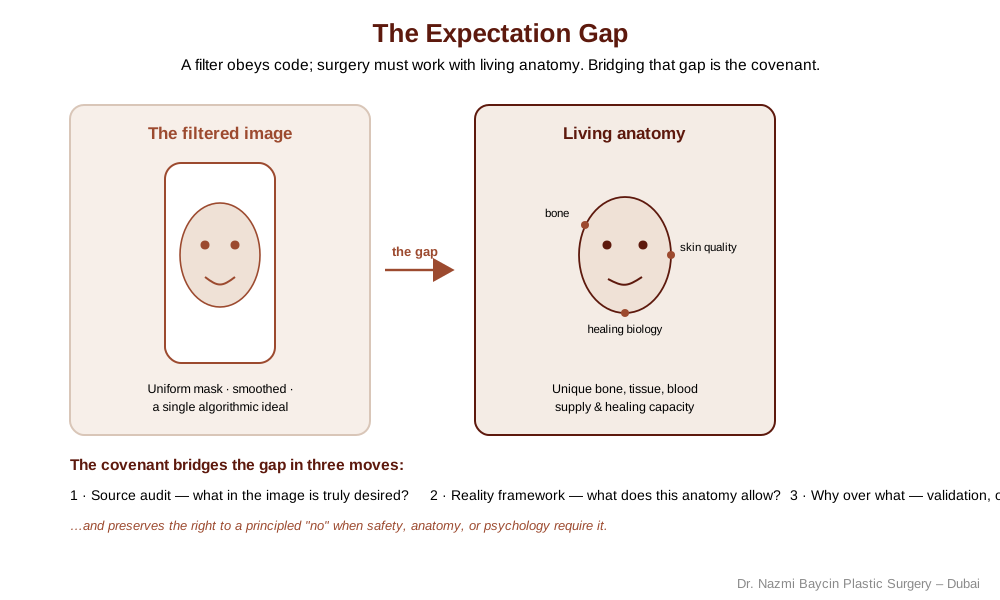
The expectation gap: a filtered ideal versus living anatomy, and the covenant that bridges it — by Dr. Nazmi Baycin, Dubai.
The covenant of truth: managing the expectation gap
The core of my professional covenant is radical transparency to bridge the expectation gap. This involves a multi-step process of ethical expectation management, which I summarize below.
| Step | What I ask / do | What it reveals |
|---|---|---|
| The source audit | We discuss the inspiration images: what is it in this picture that you want? | Differentiates a desire for general vitality from an obsession with a single, often unattainable feature |
| The reality framework | Using clinical photography, I illustrate the limits set by your own anatomy — skin elasticity, bone dimensions, fat distribution | Shows why certain trending procedures could be unnatural or unsafe for you specifically |
| The motive over the request | We explore the emotional driver behind the request | Distinguishes social validation, a fragile foundation, from personal confidence, a durable one |
This process transforms the consultation from a transactional request into a collaborative planning session. It is here that I outline how my approach to plastic surgery procedures in Dubai must account for each patient’s unique tissue characteristics and healing profile, not just a desired photo.
The ethical use of surgical media: my duty of authentic representation
If social media is part of the problem, it must also be part of the ethical solution. My practice’s representation of results is governed by a strict covenant of authenticity. All before-and-after galleries use consistent, standardized lighting, angles, and neutral expressions — no filters, no deceptive poses. I showcase a spectrum of results, including subtle refinements rather than only dramatic transformations, and I discuss the individual’s goals and the specific techniques used, educating viewers on the process rather than just the endpoint. Where I share patient testimonials, they speak to the experience — the decision-making, the recovery, the regained confidence — not just the final image. This builds a counter-narrative to the digital mirage, attracting patients who value honesty and are partners in a realistic process.
The surgeon’s resolve: upholding the refusal in an age of yes
The most critical aspect of the covenant is the preserved right to decline. Social media culture promotes a boundless yes — to every desire, every trend. My professional ethics are rooted in the wisdom of a principled refusal. I will not perform a procedure if the desired outcome violates anatomical safety or would guarantee an unnatural appearance; if the patient’s psychology suggests body dysmorphic disorder (BDD) or a motivation rooted in external coercion; or if the expectation is for a result that is technically impossible given their unique physiology.
This is not a small concern. A systematic review and meta-analysis of 33 studies pooled the prevalence of body dysmorphic disorder among plastic surgery patients at 15.04% — many times the rate reported in the general population, which is usually put below 3%. The figure deserves a caveat, though, and I would rather give it than not: the individual studies behind that average ranged from 2.21% to 56.67%, a spread wide enough that the pooled number should be read as an indication that BDD is common in this setting rather than as a precise rate. Different reviews, using different screening tools and settings, land anywhere from roughly 13% to 19%.
What is not in doubt is the clinical implication. Because people with BDD typically do not find that cosmetic procedures relieve their distress, recognizing the possibility and referring for appropriate psychological support is an act of care, not rejection. Upholding this refusal protects the patient, the profession’s integrity, and the surgeon’s conscience. It is the ultimate demonstration that my allegiance is to their well-being, not to their social media feed.
Beyond the trend, toward the timeless
The surgeon’s covenant in this digital age is a promise to be a guide and a guardian — a commitment to navigate the noisy, trend-driven landscape of beauty ideals and anchor the patient’s journey in the timeless principles of anatomy, individuality, and ethical care. The goal is not to create a patient who looks done for a viral moment, but to reveal a person who feels authentically themselves for a lifetime. This same philosophy shapes every conversation I have with a patient — a partnership built on trust and biological science rather than the pursuit of a trending look. For those seeking a surgeon who prioritizes honest dialogue and realistic outcomes over digital fantasy, I welcome you to begin a conversation with me as a cosmetic surgeon in Dubai.
FAQs: cosmetic surgery expectations in the social media age
-
Can plastic surgery make me look like my filtered photo?
Not literally, and an ethical surgeon will tell you so. A filter applies a uniform digital mask that ignores your actual bone structure, skin quality, and healing biology, whereas surgery must work with your real, living anatomy. The realistic goal is not to replicate a pixelated image but to achieve a natural result that harmonizes with your own features. A good consultation reframes the question from whether you can be made to look like a particular photograph to what will genuinely suit and balance your own face or body.
-
Should I bring reference photos to my consultation?
Yes, and I would rather you did. Reference images tell me far more about what you want than adjectives can, and they give us something concrete to work from. What matters is how we read them together: I will ask which specific quality in the picture appeals to you, whether the image has been filtered or retouched, and how the anatomy in it compares with your own. Bringing a photograph is not a red flag. Expecting to be turned into the photograph is the part we need to talk through, and that conversation is far easier to have with the image in front of us.
-
What is body dysmorphic disorder, and why does it matter before surgery?
Body dysmorphic disorder is a mental-health condition involving a distressing preoccupation with a perceived flaw that others may barely notice. It matters because it appears to be considerably more common among people seeking cosmetic procedures than in the general population — a meta-analysis of 33 studies pooled the figure at about 15%, though individual studies varied very widely — and because surgery typically does not relieve the underlying distress. Recognizing the possibility and referring for psychological support is a form of genuine care, since the concern is not one a scalpel can resolve.
-
How can I set realistic expectations before cosmetic surgery?
Start by interrogating your inspiration images honestly: identify what specifically you want and whether it suits your anatomy. In consultation, ask the surgeon to show — using standard clinical photography, not filters — what your own tissue realistically allows. Explore your motivation, too: a desire for personal confidence is a far more durable basis for surgery than seeking external or social-media validation. A surgeon who slows the conversation down to do this is protecting your long-term satisfaction.
-
How do I tell an honest before-and-after gallery from a misleading one?
Look for consistency and context. Honest galleries use standardized lighting, angles, and neutral expressions across the before and after images, with no filters or flattering poses that exaggerate the change. They also show a spectrum of results, including subtle refinements, and explain the techniques and the recovery involved rather than only presenting a dramatic endpoint. If every result looks identically perfect and heavily stylized, treat it with caution.
-
Is it a red flag if a surgeon promises to match a trend or an influencer’s look?
Yes. Trending looks are shaped by algorithms and by the anatomy of the person they were photographed on, and a blanket promise to replicate one ignores your unique structure. A trustworthy surgeon treats trending requests as a starting point for discussion, not a guarantee, and will explain whether the look is safe, natural, and achievable for you specifically. Caution toward trend-chasing is a sign of integrity, not a lack of skill.
-
Does social media genuinely change what patients ask for?
Most surgeons would say yes, and the professional literature has begun to describe it, though it is worth knowing that the published work so far is largely narrative rather than measured. What is clear from practice is that patients now arrive with reference images far more often than they once did, and that those images are frequently filtered. This is precisely why an educational, expectations-focused consultation matters: the conversation has to bridge the gap between a digital ideal and what surgery can actually and safely deliver.
-
What should a good consultation actually feel like?
It should feel like collaborative planning rather than a sales transaction. Expect the surgeon to ask why you want a change, to show you honestly what your anatomy allows, to discuss a range of possible outcomes including subtle ones, and to be willing to decline where appropriate. You should leave understanding both the possibilities and the limits, feeling informed rather than sold to. That measured, honest tone is the clearest sign you are in careful hands.
A quiet, firm commitment to what is real
In a world shouting for more — more alteration, more drama, more conformity — this covenant is a quiet, firm commitment to what is right, real, and lasting. It is the promise to reveal a person who feels authentically themselves, rather than to manufacture a look for a viral moment. For those who value that approach, I welcome you to begin a conversation at my practice in Dubai.


GET APPOINTMENT
Get ready to look and feel best… You deserve…
