

Key takeaways: why filler BBL is dangerous
- The buttock is a high-pressure, richly vascular zone, not an inert canvas for injected volume.
- Filler here risks vascular occlusion, tissue necrosis, and fatal embolism.
- It also causes deep infection, granulomas, migration, and sagging, lumpy contours.
- Reversibility of hyaluronic acid offers no meaningful protection in this anatomy.
- Correcting a filler disaster is far more complex than a primary surgical procedure.
- The only safe augmentation is surgical: fat transfer (BBL) or a medical-grade implant.
The anatomical reality: a zone of vital structures
The buttocks are not an inert canvas; they are a dynamic, highly vascularized anatomical crossroads. The gluteal region contains the superior and inferior gluteal arteries — major vessels that can suffer irreversible occlusion or embolism from filler material; the sciatic nerve, the largest nerve in the body, vulnerable to compression injury; and a layered structure of muscle, fat compartments, and skin with specific weight-bearing demands. Injectable fillers — whether hyaluronic acid, biostimulatory substances like PLLA, or worse, illegal permanent substances like silicone — are designed for superficial, static areas. They are not engineered for the deep, high-mobility, high-pressure environment of the buttocks. Their implantation here is an off-label use that disregards basic biomechanics and vascular anatomy, placing short-term volume above long-term health.
The catalog of complications: from migration to catastrophe
The problems arising from this practice are not rare; they are predictable and often severe, as summarized below.
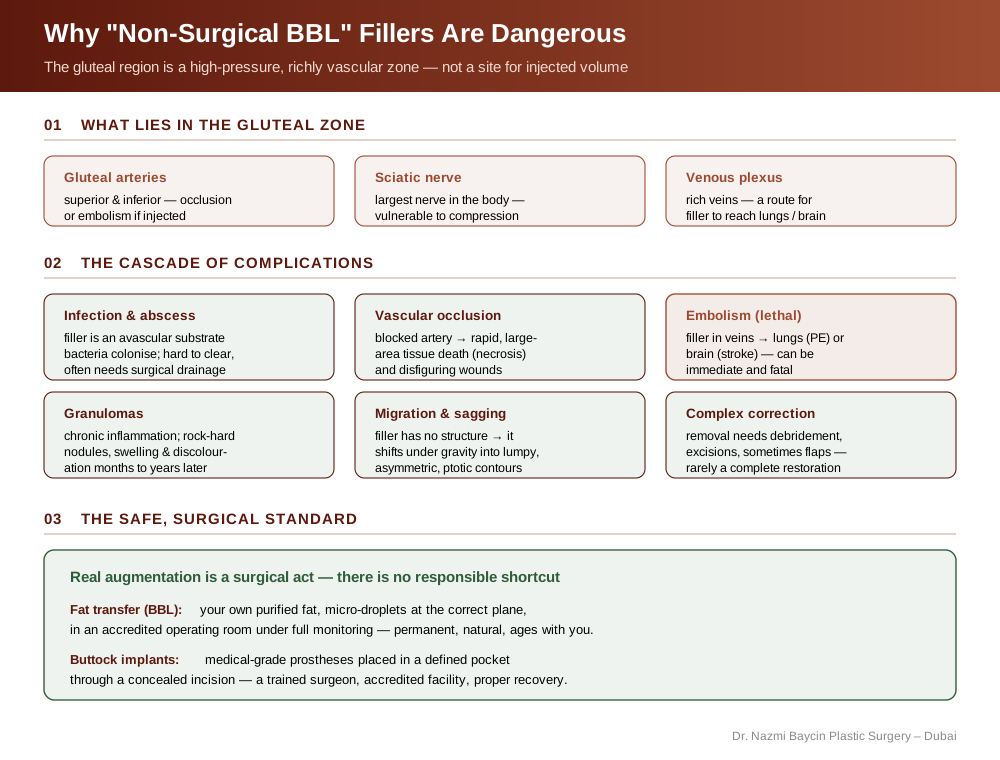
The dangers of filler injection for buttock augmentation in Dubai — the vital structures at risk, the cascade of complications, and the safe surgical alternatives — by Dr. Nazmi Baycin, Dubai.
Infection and abscess formation
The gluteal region is prone to bacterial contamination. Injections in non-sterile settings or with poor technique introduce pathogens deep into tissue. The filler mass, which the body cannot absorb, becomes an avascular substrate for bacteria to colonize, causing deep infections and painful abscesses. These are notoriously hard to eradicate with antibiotics alone, often requiring surgical drainage, extensive debridement, and complete removal of the infected filler — with significant tissue damage and scarring.
Vascular occlusion and tissue necrosis
Filler injected into or compressing a gluteal artery can block blood flow, causing rapid, large-area tissue death. The result is not just contour deformity, but massive, infected wounds requiring extensive, disfiguring debridement and lifelong scarring. The wider context is documented: a 2023 review of minimally invasive buttock augmentation records that of the available options for gluteal volume enhancement none is free of complications, and that the appeal of filler has driven a growth in unlicensed, non-medical practitioners administering these injections illicitly at low cost.
Pulmonary embolism and stroke
This is the most lethal risk. Filler entering the venous system through the rich gluteal plexus can travel to the lungs, causing respiratory failure, or through cardiac shunts to the brain, causing stroke. These events can be immediate, unpredictable, and fatal — a 2023 case report of a fatal pulmonary embolism after gluteal filler describes a 26-year-old woman with no relevant medical history who reached an emergency room in shock sixteen hours after an injection at a Cairo centre, with an oxygen saturation of 60 percent on room air. The material recorded in that case was fluid silicone.
Chronic inflammation and granulomas
The body recognizes filler as foreign, often triggering chronic inflammation. This can produce painful, rock-hard nodules (granulomas), persistent swelling, and skin discoloration that may appear months or years later.
Unnatural aesthetics and migration
Fillers lack structural integrity. Under gravity and muscle movement they migrate, creating asymmetrical, lumpy, and sagging contours. The sought-after projection dissipates into a misshapen, visibly artificial appearance. These are not mere side effects; they are systemic medical emergencies and profound aesthetic failures. My corrective body contouring work in Dubai frequently involves addressing these outcomes, which are far more complex to repair than primary augmentation.
| Factor | Injectable filler (“non-surgical BBL”) | Surgical standard (fat transfer) |
|---|---|---|
| Setting | Often non-clinical, non-sterile | Accredited operating room, full sterility |
| Operator | Frequently non-surgical, untrained in gluteal anatomy | Board-certified plastic surgeon |
| Vascular safety | No means to manage embolism or occlusion | Anatomy-avoiding technique; complications managed intraoperatively |
| Material | Foreign substance the body cannot integrate | Your own fat, or a medical-grade implant |
| Longevity | Migrates, lumps, sags; may need removal | Permanent, natural, ages with the body |
| If it goes wrong | Emergency; debridement, flaps, rarely fully restorable | Managed within a planned surgical pathway |
The surgical standard: why gluteal augmentation is a procedure of precision
Contrast this with the established, safety-focused gold standard: buttock augmentation with fat grafting or implants. My approach is grounded in respect for anatomy. In fat grafting (BBL), the patient’s own purified fat is injected in micro-droplets into the correct plane with precise cannulas, following rigorous protocols that avoid the deep vascular structures — giving natural, permanent enhancement. This is a surgical procedure performed in accredited operating rooms with appropriate anesthesia and sterility. It requires extensive training, a three-dimensional understanding of anatomy, and the ability to manage complications intraoperatively. The non-surgical filler alternative bypasses every one of these safeguards. To understand the safe, surgical path, visit Brazilian butt lift surgery in Dubai.
The ethical imperative: confronting an unregulated market
The promotion of filler injections for buttocks often occurs in non-clinical settings by practitioners lacking surgical training and a full understanding of gluteal anatomy. They cannot surgically manage the vascular catastrophes they may cause. This creates an ethical crisis where profit is prioritized over the duty to “first, do no harm.” My covenant with patients is radical honesty: the promise of a “non-surgical” butt lift is a biomedical fantasy. True, safe augmentation requires either the biological integration of your own tissue or the precise placement of a medical-grade implant — both surgical acts. There is no responsible shortcut.
The financial and human cost of correction
The pricing for illegal or off-label filler injections may seem attractive, but it is a catastrophic false economy. The true cost emerges when patients need emergency hospitalization for necrosis or embolism, or complex, multi-stage revision surgery to remove filler, debride dead tissue, and attempt reconstruction with flaps or grafts. These corrective surgeries are exponentially more expensive, painful, and emotionally draining than a primary, properly performed procedure. The human cost — physical trauma, permanent scarring, and psychological distress — is incalculable. The details of a safe surgical plan, and its cost, are discussed transparently at consultation. This commitment to anatomical truth runs through all of my body contouring work in Dubai.
FAQs about safe buttock augmentation in Dubai
-
What exactly is a non-surgical BBL and why is it dangerous?
A non-surgical BBL is a marketing term for injecting dermal fillers — most commonly hyaluronic acid, PLLA, or illicit permanent substances such as silicone — directly into the buttock tissue to create volume. The term is dangerous precisely because it implies equivalence with the Brazilian Butt Lift while completely bypassing the anatomical safeguards that make surgical augmentation survivable. The gluteal region contains the superior and inferior gluteal arteries and the sciatic nerve within a complex, high-pressure, weight-bearing tissue environment. Injecting foreign volume into this anatomy risks embolism, necrosis, infection, and permanent neurological injury — outcomes that no responsible practitioner can manage without surgical and intensive care resources.
-
Is hyaluronic acid filler safer for the buttocks because it is reversible?
No — and this is one of the most dangerous misconceptions in aesthetic medicine. The reversibility of hyaluronic acid with hyaluronidase applies only when the filler is accessible and the damage has not progressed. Vascular occlusion in the gluteal region can cause large-area tissue death within hours, long before any reversal agent could be administered. The volume of filler required for meaningful gluteal augmentation is also orders of magnitude greater than facial applications, meaning the risk of vascular compromise is proportionally higher. Reversibility is a property of the molecule in a laboratory; in a high-pressure vascular anatomical zone, it offers no meaningful protection.
-
What should I do if I have already had filler injected into my buttocks?
You should seek assessment from a board-certified plastic surgeon as soon as possible, particularly if you have any symptoms: pain, discoloration, lumps, asymmetry, fever, or changes in sensation. Many complications from gluteal filler develop over months or years rather than immediately, but early assessment can identify warning signs before they become emergencies. Removal of certain filler types — particularly permanent substances like PMMA or silicone — is surgically complex and cannot be reversed by injection. The sooner the situation is assessed by a qualified surgeon, the more options remain available.
-
Why should an aesthetician or non-surgical practitioner not perform buttock augmentation?
Because the complications that can arise — arterial embolism, large-area tissue necrosis, deep infection — are surgical and intensive care emergencies that require immediate operative intervention. A practitioner without surgical training and access to an operating theater cannot respond to these events. This is not a critique of their skill in facial injections; it is an anatomical reality that the gluteal region operates under different biological rules. The standard of care requires that anyone injecting near major vessels must have the training to recognize and manage vascular injury — which excludes non-surgical practitioners by definition.
-
What are the safe alternatives for buttock enhancement?
Two established surgical options exist. The Brazilian Butt Lift (BBL) uses purified fat taken from the patient, transferred in micro-droplets at the correct anatomical plane under rigorous safety protocols in an accredited operating room with full anesthetic monitoring. The fat integrates permanently and ages naturally with the body. The second option is buttock implants — medical-grade silicone prostheses placed in a subfascial or intramuscular pocket through a concealed incision. Both options require a trained plastic surgeon, an accredited facility, and appropriate recovery; neither can be replicated safely in a clinic setting with injectable materials.
-
If a non-surgical BBL has already gone wrong, how complex is the corrective surgery?
Significantly more complex than primary augmentation — and often incompletely resolvable. Infected or necrotic tissue must be surgically debrided, sometimes extensively, before any reconstructive attempt. Permanent fillers cannot be fully removed without significant collateral tissue damage because they infiltrate between tissue planes. Granulomas may require repeated excisions. Where tissue has been lost to necrosis, reconstruction often requires flap surgery or skin grafting, leaving permanent scarring in an area that is both visible and functionally important. The time, expense, and physical and psychological burden of correction far exceed anything a primary surgical procedure would have required — and a complete restoration is rarely achievable.
Choosing anatomical truth over dangerous myth
The gluteal region demands respect. The problems associated with filler injection for augmentation are not anecdotal; they are the direct, logical consequence of violating anatomical truth. My role as a surgeon is to defend that truth. For anyone considering enhancement, the choice is clear: pursue a path that honors your body’s structure through a certified surgical gold standard, or risk becoming a casualty of an unregulated and dangerous shortcut. The integrity of your body is not a place for compromise. I urge patients to seek consultation only with a fully-trained, board-certified plastic surgeon in Dubai who can offer safe, sustainable solutions and stand by their results.


GET APPOINTMENT
Get ready to look and feel best… You deserve…
