

Key takeaways: aesthetic refinement as a lifelong architecture
- Plastic surgery is best approached as a staged lifelong journey, not a single drastic event.
- The goal is not to look twenty at fifty, but to look unquestionably magnificent at fifty.
- Proportional enhancement matches each intervention to the degree of change and the individual’s baseline.
- The three acts move from refinement (30s–40s) to restoration (40s–50s) to harmonization (60s+).
- A surgeon who guides the whole journey sees the entire film, not a snapshot.
- Restraint is part of the plan — within a staged sequence, the commonest advice is not yet rather than never.
The foundational principle: proportional enhancement
True aesthetic elegance is not the absence of age, but the harmonious presence of self throughout time. The goal is never to look twenty at fifty, but to look unquestionably magnificent at fifty, and this requires the principle of proportional enhancement. An intervention must be in harmony with two things: the degree of anatomic change presented, and the individual’s unique baseline. A procedure too subtle for significant laxity is ineffective; a procedure too aggressive for early signs is destructive.
The notorious “overdone” look is typically the result of a drastic, belated attempt to reverse decades of change in one sweep — applying a solution of a magnitude the face cannot integrate naturally. My approach counters this with smaller, strategic interventions made over time, preserving natural expression, allowing tissues to adapt, and ensuring every result looks inherent, not implanted.
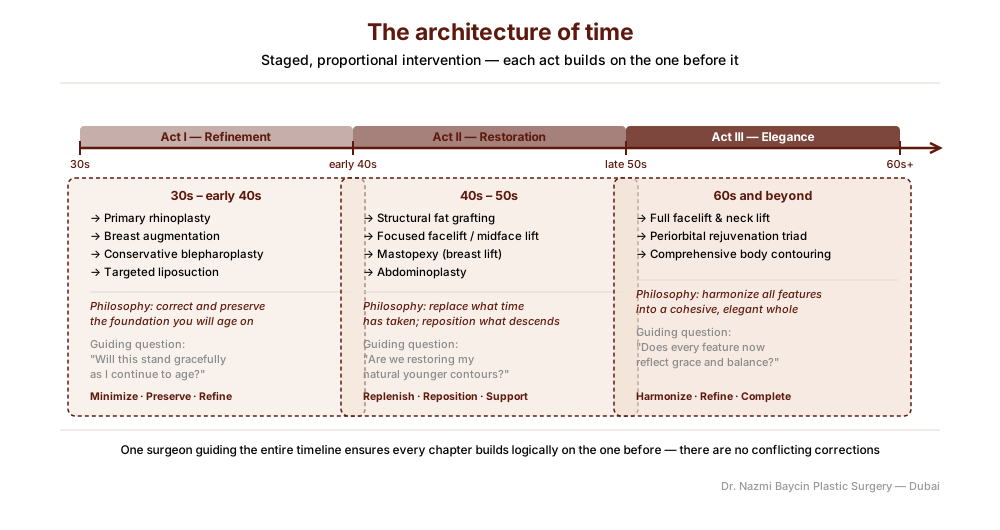
The architecture of time — aesthetic refinement staged across three life acts, from preservation to restoration to harmonization — by Dr. Nazmi Baycin, Dubai.
The table below summarizes how the philosophy and the guiding question shift across the three acts.
| Act | Stage & philosophy | Guiding question |
|---|---|---|
| I — Refinement | 30s–early 40s: selective correction and preservation | Will this stand stably as the foundation on which I age? |
| II — Restoration | 40s–50s: replenish volume, reposition early descent | Are we authentically restoring my younger self’s contours? |
| III — Harmonization | 60s+: comprehensive, natural refinement of the whole | Does this bring every feature into peaceful, harmonious balance? |
Act I: the age of refinement (30s – early 40s)
This first act is not about combating age but about perfecting foundation, addressing inherited traits or early, specific concerns with a philosophy of selective correction and preservation. The mindset is minimally invasive or foundational techniques that refine rather than reconstruct.
A primary rhinoplasty in Dubai can correct structural imbalances or breathing issues, establishing facial harmony for decades. A primary breast augmentation in Dubai can restore volume lost after pregnancy or weight change using techniques that respect future potential. A conservative, fat-preserving blepharoplasty in Dubai addresses genuine hereditary hooding, and targeted liposuction refines localized, diet-resistant deposits. The guiding question is always: will this correction stand stably and gracefully as the foundation upon which I age?
Act II: the age of restoration (40s – 50s)
Here the narrative shifts, as the first significant movements of aging appear: volume depletion, soft descent, and a loss of crisp definition. The philosophy pivots from correction to restoration — techniques that replace what time has taken and reposition what has begun to descend. Structural fat grafting is the cornerstone, using your own living tissue to replenish the cheeks, temples, and hands.
A focused facelift in Dubai — a limited-incision SMAS or midface lift — addresses early jowling and neck laxity, ideally integrated with fat grafting to avoid a flattened look. A breast lift (mastopexy) in Dubai restores nipple position and shape after childbearing, and an abdominoplasty in Dubai repairs diastasis and restores core contour after pregnancies. The guiding question: are we authentically restoring the natural, full contours of my younger self?
Act III: the age of elegance (60s and beyond)
This final act is not a surrender to age but the masterful composition of maturity, aiming for comprehensive refinement that harmonizes all features into a cohesive, elegant whole. The mindset is artistically precise procedures that prioritize a natural, non-operative elegance — to look impeccably refined, not oddly young.
A full facelift and neck lift artistically reposition significant skin and muscle laxity, invariably combined with delicate fat grafting for a soft, supported result. A tailored periorbital rejuvenation — upper and lower blepharoplasty, canthopexy for support, and fat grafting — addresses both hooding and hollowing while preserving a warm, expressive gaze.
And for significant laxity after weight loss or aging, comprehensive body contouring in Dubai focuses on natural proportion and silhouette rather than extreme transformation. The guiding question: does this bring every feature into a state of peaceful, harmonious balance that reflects my life’s experience with grace?
How the acts connect: planning transitions, not just procedures
The acts are not isolated chapters; the quiet discipline of this philosophy lies in how each one anticipates the next. When I perform a conservative blepharoplasty in Act I, I deliberately preserve the orbital fat that a future Act II fat-grafting session will build upon. When I plan a limited facelift in Act II, I place and orient the incisions so that a fuller lift in Act III, if it is ever wanted, can proceed cleanly through friendly tissue rather than through compromise.
Each decision is made with one eye on the operation in front of me and one eye on the decades ahead. Between stages, the plan is actively stewarded rather than left dormant. I see my long-term patients at unhurried intervals, photograph consistently so change is measured rather than guessed, and watch the pace of each individual’s aging — because tissue quality, weight stability, sun exposure, and genetics all bend the timeline.
Some patients reach the threshold of Act II years later than expected and simply need reassurance, not surgery; others arrive early after major weight change or illness and need the sequence gently reordered. The calendar proposes; the anatomy decides.
The irreplaceable role of the guide: the surgeon who sees the timeline
This lifelong philosophy hinges on a partnership that cannot be replicated by seeing a different surgeon for each act. A surgeon who performs a single procedure sees a snapshot; a surgeon guiding you through the journey sees the entire film. I learn the unique character of your tissues — how they heal, how they age, how they respond — and this intimate knowledge lets me ensure each intervention builds logically upon the last. I understand the scar from a procedure done a decade prior, I know how your fat grafts integrated, and I can anticipate how your skin will respond to a future lift. This continuity is the ultimate safeguard against the disjointed, conflicting results that arise from a fragmented approach.
The ethical foundation: when the answer is not yet
Within a staged plan, restraint is mostly a question of timing. The commonest thing I decline is not a procedure but a date — an operation too aggressive for the stage of life in front of me, or one that would foreclose a better option two acts later. Saying not yet protects the sequence, because a step taken early is a step that cannot be taken as well again. Aging is not a pathology to be cured; it is the natural process of a life fully lived. The wider question of when an operation should be declined outright rather than deferred — unrealistic expectation, psychological contraindication, an unfavourable balance of risk and benefit — belongs to my article on the judgment behind refusing to operate.
My philosophy does not seek to defeat time but to engage with it intelligently and artistically — a roadmap to perpetually feeling like the most authentic, confident version of yourself. That perspective is at the heart of my work as a leading plastic surgeon in Dubai.
FAQs about staged, age-appropriate cosmetic surgery in Dubai
-
When is the right time to start thinking about cosmetic surgery?
There is no single right age — the right time depends on what is actually changing in your face or body and how it relates to your baseline. Rather than a fixed number, the philosophy is proportional: a small, well-timed intervention early can preserve a foundation, while waiting for a specific concern to genuinely appear is better than preventative surgery on features that have not yet changed. A good consultation maps this to your individual anatomy.
-
What is proportional enhancement?
It means matching the size of an intervention to two things: how much anatomic change has actually occurred, and your unique starting point. A procedure too subtle for significant laxity will not help; one too aggressive for early changes looks unnatural. The overdone look usually comes from trying to reverse decades of change in one drastic step. Smaller, strategic steps over time let tissues adapt and keep results looking inherent rather than implanted.
-
Why do you divide the lifespan into three acts?
The three acts are a framework, not rigid rules. Broadly, the 30s to early 40s are about refinement and preserving a good foundation; the 40s to 50s shift toward restoring lost volume and repositioning early descent; and the 60s and beyond focus on harmonizing all features into a natural, elegant whole. Everyone moves through these at their own pace — the acts describe how the goals of surgery evolve, not a fixed timetable.
-
Would it be better to have one big operation later rather than several over time?
For many people, staged, proportional intervention produces more natural results than a single dramatic overhaul. A belated attempt to reverse decades of change at once is exactly what tends to create the tight, operated look. Spacing thoughtful steps over time preserves natural expression, lets tissues adapt, and allows each result to settle before the next chapter. That said, combining procedures at one stage is sometimes appropriate — it is decided case by case.
-
Why does it matter to have the same surgeon over the years?
Continuity is a genuine safeguard. A surgeon who has guided you over time knows how your tissues heal, how previous fat grafts integrated, where earlier scars sit, and how your skin is likely to respond to a future procedure. That knowledge lets each intervention build logically on the last, avoiding the disjointed, sometimes conflicting results that can come from a fragmented approach with a different surgeon for each step.
-
Will you ever tell me it is too early for a procedure?
Often, and it is one of the more useful things I do. Within a staged plan the commonest advice is not no but not yet — a feature that has not changed enough to justify an operation, or a procedure that would foreclose a better option later in the sequence. Waiting is rarely wasted, because a well-timed smaller step usually outperforms an early larger one. Whether an operation should be declined outright rather than deferred is a separate question, which I answer in my article on the judgment behind refusing to operate.


GET APPOINTMENT
Get ready to look and feel best… You deserve…
