

Key takeaways: safety before volume
- The buttock’s deep plane holds large, non-collapsible veins linked to the lungs and brain.
- The cardinal rule: no graft is ever placed deep to the muscle fascia.
- Deep-muscle injection is the single factor most tied to fatal fat embolism.
- Graft survival depends on a triad: gentle harvest, careful purification, precise placement.
- Fat is placed in micro-aliquots with a constantly moving cannula — never a static bolus.
- Roughly 40–60% of the graft integrates permanently; the goal is harmony, not maximal size.
Beyond volume: the science of structural augmentation
In my practice, the BBL is defined by a deliberate departure from high-volume fashion. The focus is the biological integration of fat as a living graft within a precisely engineered recipient site. This is applied surgical anatomy and tissue biology, not a commercial volume contest — and it begins with respecting the region’s vascular map.
The gluteal danger zone: a vascular roadmap for survival
The paramount concern in gluteal augmentation is avoiding fatal fat embolism. This risk is not abstract; it is directly tied to violating a specific anatomical plane. The gluteal region is layered, and each layer carries a very different level of risk, as summarized below.
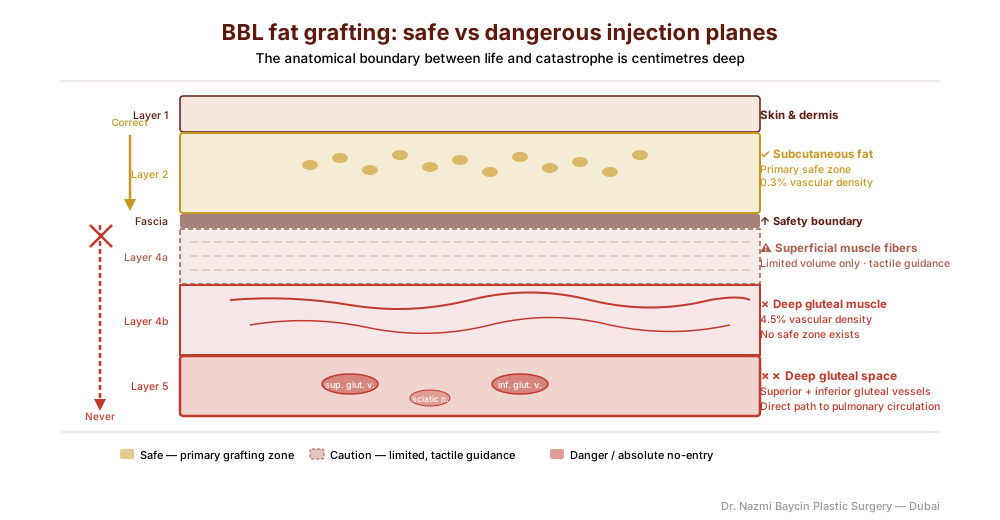
The safe injection planes for gluteal fat grafting — graft confined to the subcutaneous and immediately supra-fascial planes, with the deep gluteal space containing the major vessels marked as an absolute no-entry zone — by Dr. Nazmi Baycin, Dubai.
These large-caliber veins are fragile, non-collapsible, and connect directly to the valveless Batson’s plexus, which leads to the pulmonary and cerebral circulations. The cardinal rule of my practice is absolute: no grafting material is ever placed deep to the muscle fascia. Injecting into the deep muscle or submuscular plane risks direct intravascular injection or laceration of these major veins, allowing fat to enter the systemic circulation with catastrophic consequences.
This is not a matter of preference but of evidence: the 2017 ASERF Task Force report on mortality from gluteal fat grafting found that surgeons who injected into the deep muscle had a significantly higher rate of fatal and non-fatal pulmonary fat emboli. My entire technique is engineered to respect this boundary, confining graft placement to the subcutaneous and immediately supra-fascial planes only, where smaller, collapsible vessels pose a dramatically lower risk.
| Anatomical layer | Contents | Grafting status |
|---|---|---|
| Skin & subcutaneous fat | Superficial layer, small collapsible vessels | Primary graft zone — safe |
| Superficial gluteal fascia | Key anatomical boundary | Reference plane |
| Superficial muscle fibers | Most superficial gluteus maximus | Limited graft, tactile-guided only |
| Deep muscle / deep gluteal space | Superior & inferior gluteal vessels, Batson’s plexus | Absolute no-entry — danger zone |
The triad of fat graft survival: harvest, processing, and placement
Long-term volume retention depends on maximizing the viability of each adipocyte throughout its journey. My protocol rests on three pillars.
The art of gentle harvesting
Trauma begins at harvest. I use low-pressure, manual aspiration with multi-hole, blunt-tip cannulas of 3–4mm diameter. This method, though more time-consuming than machine liposuction, preserves adipocyte architecture and minimizes cellular ischemia. The donor site — often the abdomen, flanks, or thighs — is treated with the same respect as the recipient site, as part of a holistic 360° strategy. To learn more about the donor-site sculpting that supplies the graft, visit liposuction surgery in Dubai.
The science of purification
Lipoaspirate is not simply “fat”; it is a mixture of viable adipocytes, blood, free lipids, and local anesthetic. I use a closed-system, low-G-force centrifugation protocol. This standardizes the graft into a concentrated, living cellular transplant while aggressively removing the inflammatory components — blood and oil — that increase cyst formation and reduce survival. This step is non-negotiable for predictability.
The precision of structural placement
This is the defining phase. Using long, blunt-tip infiltration cannulas, I deposit purified fat in micro-aliquots of 0.5–1cc per pass, following a multiplanar, fanning technique. The majority of the graft goes into the subcutaneous layer, in tight radiating tunnels that create a broad, natural base of projection. A limited volume may be placed in the most superficial fibers of the gluteus maximus, under direct tactile feedback to ensure the cannula tip is never deep. This “rice grain” technique keeps each graft cylinder within about 1.5mm of a vascular supply, enabling direct perfusion and neo-angiogenesis — the new blood-vessel growth that sustains the graft long-term.
The surgical safety protocol: a step-by-step discipline
My operative conduct follows a rigid checklist designed to eliminate protocol error. The patient is marked standing to identify the “zone of danger” — the medial and central lower gluteal quadrant where the inferior gluteal vessels exit the pelvis — which is designated an absolute no-entry zone. The procedure is performed prone, so anatomical relationships stay stable and undistorted.
The moving-cannula technique is law: the tip is never stationary during injection, preventing high-pressure bolus deposition. My left hand constantly palpates the cannula tip subdermally to confirm its superficial location. And I adhere to evidence-based volume limits per session, prioritizing safety over augmentation — staging a procedure is always preferable to violating safety principles. This transforms the BBL from a potentially high-risk operation into a controlled, reproducible, and safe body-sculpting procedure in Dubai. To explore the safe, surgical procedure itself, visit Brazilian butt lift surgery in Dubai.
The realistic outcome: viability, contour, and harmony
Approximately 40–60% of the meticulously placed graft volume integrates permanently. The goal is not maximal size, but an improved contour in harmonious proportion with the patient’s lumbar lordosis, hip width, and thigh descent. A successful result appears as a natural enhancement of the existing gluteal shape, not an imposed, spherical volume. The complementary liposuction of the torso and flanks — the “360° contouring” approach — is integral, highlighting the new projection and creating a balanced, athletic silhouette. This safe, surgical philosophy stands in deliberate contrast to injectable shortcuts; to understand why non-surgical filler augmentation is so dangerous, read my article on the dangers of filler injection for buttock augmentation in Dubai.
The surgeon’s covenant in gluteal augmentation
The modern BBL, stripped of its commercialized myths, is a profound exercise in applied surgical anatomy and tissue biology. My approach is a covenant — a promise that patient safety is the immutable foundation on which aesthetic ideals are built. It demands not just technical skill, but the humility to respect anatomical no-go zones and the discipline to follow a protocol that prioritizes life over volume. Because each plan is individual, its details and cost are set out transparently at consultation. This reverence for the body’s architecture runs through all of my cosmetic surgery work in Dubai.
FAQs about safe Brazilian butt lift in Dubai
-
What makes the BBL more dangerous than other fat grafting procedures?
The gluteal region is uniquely perilous because it contains large-caliber, non-collapsible veins — the superior and inferior gluteal veins — that connect directly to the Batson’s venous plexus, which in turn drains into the pulmonary and cerebral circulations without passing through the liver’s filtering system. Fat entering these veins travels immediately to the lungs. Compare this to facial fat grafting, where the vessels are smaller, collapsible, and the consequences of any accidental intravascular injection are far less systemic. The anatomy of the buttock creates a category of risk unique to this region.
-
Why does injecting into the muscle increase the risk so dramatically?
Intramuscular vessels are significantly larger in caliber and far more densely distributed than subcutaneous vessels — research using CBCT imaging has found that intramuscular vascular density is 4.5% of the tissue area versus only 0.3% in the subcutaneous fat. A moving cannula tip in the deep muscle belly cannot avoid these vessels. Additionally, the intramuscular veins are non-collapsible under the elevated pressures of injection, making them far more likely to rupture and allow fat to enter the systemic circulation. There is no safe zone within the intramuscular plane — this is not a matter of surgical skill but of anatomical reality.
-
How much of the transferred fat will I actually keep permanently?
Approximately 40 to 60% of meticulously placed graft volume integrates permanently. This range reflects the biological variability in graft survival regardless of surgical technique. The surviving fraction is genuinely permanent — it integrates as living adipose tissue that ages naturally with the body. This is why the initial volume placed appears somewhat greater than the intended final result, accounting for the expected reabsorption period. Attempting to compensate with excessive volume to guarantee a larger final result violates safe volumetric limits and increases risk without proportionally improving outcomes.
-
Why is the moving cannula technique so important?
Stationary injection under pressure creates a bolus of fat at a single anatomical point — placing a concentrated volume directly adjacent to any nearby vessel. A cannula in motion deposits small aliquots of fat distributed along a tunnel, so no single point receives excessive pressure and each micro-deposit is separated from the next by intact tissue. This technique, combined with blunt-tip cannulas, single-hole cannulas, and continuous tactile palpation from the non-operating hand, is the cornerstone of every responsible BBL safety protocol and is non-negotiable in my practice.
-
What is the 360° contouring approach, and why is it part of the procedure?
BBL is not only about adding volume to the buttocks — it is about creating a proportional, harmonious silhouette. The simultaneous liposuction of the waist, flanks, abdomen, and lower back removes the surrounding tissue that visually competes with gluteal projection, and the harvested fat provides the donor material for grafting. Without this perimeter sculpting, even a technically excellent graft can appear underwhelming because the surrounding frame hasn’t been optimized. The fat used for grafting is a by-product of the sculpting — the two procedures are inseparable in producing a natural, athletic result.
-
Who is not a suitable candidate for BBL, and when should the procedure be staged?
A candidate must have sufficient donor fat to harvest — patients with very low body fat percentage cannot generate adequate graft volume for meaningful augmentation. Candidates must also be medically fit for the combined procedure, as the operative time is substantial. When augmentation goals exceed the safe volumetric limits achievable in a single session, staging the procedure is always preferable to violating safety principles. I will advise a staged approach whenever the desired result cannot be achieved within the boundaries of what the tissue can safely receive and what can be safely deposited in a single anesthetic.


GET APPOINTMENT
Get ready to look and feel best… You deserve…
