

Key takeaways: the honest trade-offs of fat transfer
- Fat transfer is a grafting procedure, not a controlled implant — the final volume cannot be guaranteed.
- Reported survival rates range widely, so much of the initial fullness can reabsorb over months.
- Asymmetry and contour irregularities (lumps, oil cysts) are real risks, sometimes needing further sessions.
- Fat necrosis can create calcifications that complicate future mammograms — the most serious drawback.
- Volume is limited to roughly one cup size, and requires a donor site with its own risks.
- Grafted fat tracks your body weight, adding long-term instability an implant does not have.
Primary drawback: profound unpredictability of volume retention
The most significant disadvantage is the inability to guarantee final volume, because you are not receiving a measured implant. The reality is far more unpredictable than marketing materials suggest. A 2022 narrative review of the basic science, techniques and patient management of fat grafting treats unpredictable retention as the central limitation of the method, with resorption and fat necrosis among its principal complications. Published retention figures differ so widely between studies that no single number can honestly be promised, and much of the initial fullness can dissipate over months as the body reabsorbs it.
Survival depends on neovascularization, in which each tiny graft must spontaneously develop a new blood supply. This process is fragile, and it can be disrupted by numerous factors that lie beyond a surgeon’s control. The “take rate” is a wide range, not a promise. Much of the early volume can reabsorb over three to six months, and further sessions may be needed with no better guarantee of permanence. Unlike an implant, fat transfer commits you to a biological process rather than a defined, measured outcome. That distinction is the single most important thing to understand before you begin.
Fat transfer versus implants: an honest comparison
The two routes to added breast volume involve fundamentally different trade-offs, summarized below.
| Consideration | Autologous fat transfer | Breast implant |
|---|---|---|
| Volume predictability | Unpredictable; partial reabsorption is expected | Defined, measured volume |
| Achievable size increase | Modest — roughly one cup per session | Wide range, including significant enhancement |
| Foreign material | None — uses your own tissue | Silicone or saline device |
| Screening impact | Fat necrosis can cause calcifications that complicate mammograms | Managed with specific implant-displacement imaging views |
| Stability over time | Tracks body-weight changes | Stable regardless of weight |
| Extra surgical site | Yes — donor liposuction site | No donor site |
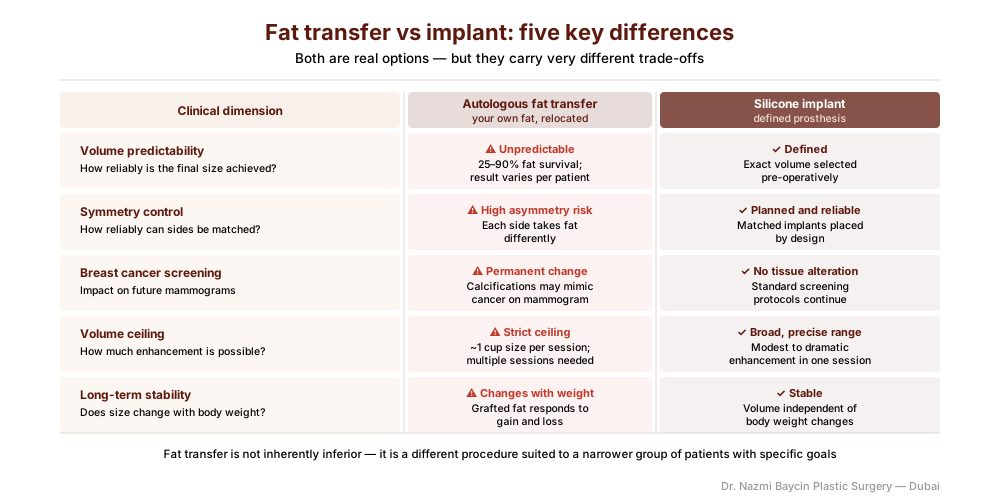
The core trade-offs between autologous fat transfer and implant-based breast augmentation — biological unpredictability versus defined, stable volume — by Dr. Nazmi Baycin, Dubai.
Significant drawback: high risk of asymmetry and contour irregularities
Your breasts have different vascular networks, and it is common for one side to support fat survival significantly better than the other. The result is post-operative asymmetry that is notoriously challenging to correct. Breasts rarely heal uniformly, so one side may retain a much greater proportion of fat than the other.
That imbalance can demand corrective sessions and turn a single surgery into a multi-stage project. Fat also does not always settle evenly. There is a notable risk of palpable lumps, oil cysts, or irregular contours that can feel firm or nodular under the skin, and some of these changes may be permanent.
While skilled technique minimizes this, the risk of an uneven, bumpy texture is a real possibility that implant surgery largely avoids. Correcting uneven volume is a recurring theme in fat-transfer revision, and where the imbalance is significant enough to warrant a second procedure, the planning becomes a reconstructive exercise rather than a simple top-up.
Critical medical drawback: lasting impact on breast cancer screening
This is the most serious, non-negotiable disadvantage, because fat transfer permanently alters your breast tissue in ways that can complicate future health screenings. When fat cells die — a natural occurrence in a percentage of grafts — the body can form calcifications. On a mammogram, these can be indistinguishable from the micro-calcifications of early breast cancer.
Indeed, a 2020 narrative review of the outcomes, safety and complications of fat grafting in cosmetic breast surgery counts calcification and fat necrosis among the recognized complications of the technique. The practical consequence is more false positives — unnecessary follow-up imaging, stressful biopsies, and significant anxiety. This is a lifelong change in your medical landscape that every future radiologist must navigate. It is the drawback I ask patients to weigh most carefully of all.
Donor-site morbidity and inadequate volume for significant enhancement
The procedure creates a second surgical site with its own risks and potential disappointments. Liposuction is not perfectly predictable, so you may trade concerns about your breasts for new irregularities, dimpling, or asymmetry at the harvest sites such as the abdomen or thighs. The supply is also limited. This procedure is not an option for slender patients, because there is simply not enough viable donor fat to create a dramatic enhancement.
In practice it is generally limited to a subtle increase of about one cup size, and patients desiring more pronounced volume will find the technique fundamentally incapable of meeting their goals. Because the harvest is itself a liposuction procedure with its own contouring consequences, to learn more about how fat is removed and body contour is managed, visit liposuction surgery in Dubai.
The drawback of weight fluctuation and long-term instability
The grafted fat behaves like the fat elsewhere in your body, which means your results are tied to your weight. Gaining weight may enlarge the breasts disproportionately, while losing weight may shrink them, potentially reintroducing asymmetry or volume loss. An implant provides stable volume regardless of body-weight changes; fat transfer does not. That link between breast size and your overall weight adds an element of long-term instability that many patients do not anticipate at the outset. For anyone whose weight naturally fluctuates through the year, I flag this early, because it can quietly undo a result that looked ideal in the first months after surgery.
Candidacy is exceptionally narrow
Given these drawbacks, the ideal candidate is rare. She desires only a very modest increase in volume, has significant excess fat in donor areas, holds realistic expectations about uncertainty and the potential for multiple procedures, and fully accepts the permanent implications for breast cancer screening. For most patients seeking reliable, noticeable enhancement, these conditions are not met, and a measured, stable implant is often the more honest route.
My role is not to steer you toward one technique, but to make sure the choice is genuinely informed. When a patient understands exactly what fat transfer can and cannot promise, the decision they reach tends to be the one they are still comfortable with years later. Both paths — and how they suit your anatomy and goals — are discussed in depth as part of my breast augmentation surgery in Dubai, where the decision is made with your goals and long-term health weighed together.
FAQs about fat transfer breast augmentation in Dubai
-
Why do surgeons and marketing materials describe fat transfer as natural and safe when there are so many limitations?
Both descriptions are partially true — fat transfer uses your own tissue, which eliminates implant-specific risks like capsular contracture or implant rupture, and it is a legitimate surgical option. The problem is that natural and safe is presented as a summary rather than a starting point. It omits the biological unpredictability of graft survival, the permanent impact on breast cancer screening, and the narrow range of patients for whom it is genuinely suitable. Marketing tends to lead with advantages; my role is to present the complete picture so you can make an informed decision.
-
What exactly causes fat to be reabsorbed after transfer?
Each transferred fat globule must establish its own new blood supply — a process called neovascularization — within the first few days after surgery. Fat that fails to make this connection dies and is gradually cleared by the immune system. The success of this process depends on how thinly the fat was deposited, the vascularity of the recipient tissue, the quality of fat processing, and your individual biological response — none of which can be fully controlled or predicted. This is why published retention figures vary so widely from study to study, rather than falling into a narrow, reliable band.
-
Can the calcifications from fat transfer be distinguished from breast cancer on a mammogram?
Sometimes, but not reliably without additional investigation. Radiologists familiar with post-fat-transfer findings can often identify calcification patterns characteristic of fat necrosis, but they can also be indistinguishable from the microcalcifications of early ductal carcinoma in situ. The consequence is that false positives become more likely — additional imaging, MRI, and biopsy may be needed in future screening rounds. This is a lifelong change to your medical landscape that deserves serious weight in the decision.
-
Is fat transfer ever the right choice for breast augmentation?
Yes — for a specific, narrow group of patients. The ideal candidate wants only a modest, subtle increase of roughly one cup size, has sufficient donor fat available for harvest, is fully informed about the biological unpredictability and its implications for future screening, and understands that multiple sessions may be needed to approach their goal. For patients who genuinely fit this profile and who specifically wish to avoid any foreign material in their body, fat transfer can be an elegant solution. The problem is that many patients who inquire about it do not fit this profile.
-
What happens to the fat at the donor harvest site?
Liposuction is performed at a secondary site — typically the abdomen, thighs, or flanks — to collect the donor fat. This site carries its own risks: contour irregularities, dimpling, and asymmetry are all possible, and some patients find they have simply traded one set of aesthetic concerns for another. It also means a second recovery site alongside the breast. For patients with limited donor fat, this limits both how much can be harvested and how much can be meaningfully transferred.
-
If I want augmentation without an implant, are there other options?
The honest answer is that fat transfer is currently the only established autologous option for breast volume increase. There are no injectable fillers approved for breast augmentation, and no other technique that achieves meaningful, lasting volume without either an implant or fat. If you are firmly opposed to implants and the limitations of fat transfer are acceptable to you, fat transfer is the genuine alternative. If neither option feels right, it is worth revisiting whether the timing is right for any augmentation rather than settling for a technique that does not match your goals.


GET APPOINTMENT
Get ready to look and feel best… You deserve…
