

Key takeaways: refine the nose, preserve the identity
- In a city this diverse, nearly every rhinoplasty is ethnic rhinoplasty — planned around individual anatomy, not a template.
- The goal is enhancement, not erasure: refinement that keeps the nose unmistakably the patient’s own.
- Ethnic patterns are a starting framework — the plan follows the individual nose and the patient’s wishes.
- Thick-skinned ethnic noses need structural grafting to hold definition against the forces of healing.
- Conservative hump reduction protects both profile and airway, avoiding mid-vault collapse.
- Final refinement in thick skin emerges slowly — over twelve to eighteen months.
I approach every rhinoplasty as a negotiation between two goals that must both be honored: the aesthetic refinement the patient seeks, and the preservation of the ethnic character that makes the nose theirs. These goals are not in conflict when the surgery is planned correctly — the art lies in achieving the refinement without the erasure. Working with this full spectrum of nasal anatomy in Dubai, this is the balance I consider the defining skill of ethnic rhinoplasty.
Why ethnic rhinoplasty requires a different surgical mindset
Nasal anatomy varies significantly across ethnicities — in the structure of the bone and cartilage, the thickness and behavior of the skin, the projection and definition of the tip, and the width of the nasal base. A surgical approach calibrated for one anatomy applied to another produces predictable failures: over-resection causing structural collapse, an unnaturally scooped profile that conflicts with strong facial features, a tip refined beyond what the skin can support, or a nose that no longer belongs to the face it sits on.
The clinical evidence supports this individualized approach; a 2025 meta-analysis pooling seventeen comparative studies of ethnicity-conscious rhinoplasty found significantly greater patient-reported satisfaction where technique was tailored to individual anatomy rather than applied conventionally (standardized mean difference 0.68, 95% CI 0.63 to 0.73), alongside lower pooled complication and revision rates — 8.7% against 17.4%, and 5.3% against 12.1%. The seventeen studies were comparative but not randomized, so this is a consistent association across the published series rather than a trial result.
The mindset shift is fundamental: I do not plan a rhinoplasty around what ethnic group a patient belongs to, but around the specific anatomical findings of their individual nose and their individual aesthetic wishes — using the understanding of ethnic anatomical patterns as a starting framework, not a template.
Nasal anatomy across ethnicities: what I plan for
While every nose is individual, recognizable anatomical patterns recur within ethnic groups, and understanding these patterns informs the surgical plan. These are starting points for assessment — not rigid categories.
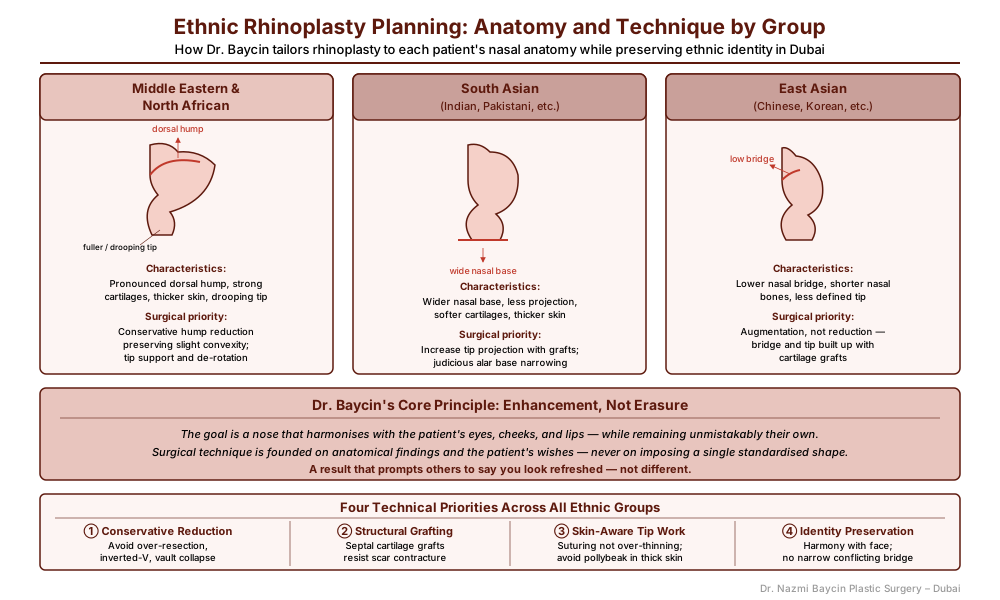
The three most common ethnic nasal profiles — Middle Eastern and North African (pronounced hump, conservative reduction), South Asian (wide base, projection and grafting), and East Asian (low bridge, augmentation) — around the core principle of enhancement, not erasure, and four technical priorities applied across all groups: conservative reduction, structural grafting, skin-aware tip work, and identity preservation — by Dr. Nazmi Baycin, Dubai.
Middle Eastern and North African noses
The Middle Eastern and North African nose — the most common ethnic profile in my Dubai practice — frequently presents with a pronounced dorsal hump, strong and thick cartilages, thicker skin with more sebaceous quality, and a tip that tends to droop or lack definition. The surgical priorities here are conservative hump reduction that preserves a natural, slightly convex profile rather than creating an artificial scoop; robust tip support to correct drooping and establish definition through the thicker skin; and structural reinforcement that resists the contractile forces of healing in skin that holds swelling longer. Over-reduction of the Middle Eastern nose toward a small, scooped, Western shape is the classic error — producing a nose that looks operated, conflicts with strong surrounding features, and frequently collapses functionally over time.
South Asian noses
The South Asian nose — patients of Indian, Pakistani, Bangladeshi, and Sri Lankan heritage — often features a wider nasal base, less tip projection, softer and weaker cartilages, and thick skin. The strategy differs significantly from the Middle Eastern nose: rather than reduction, the priority is frequently augmentation and structural building — increasing tip projection and definition with cartilage grafts, judiciously narrowing a wide nasal base while concealing scars within the natural alar creases, and establishing the structural framework that the naturally softer cartilage does not provide. The thick skin requires the same patient, structure-focused approach: definition is built underneath, and the skin redrapes over it slowly.
East Asian noses
The East Asian nose — patients of Chinese, Korean, Japanese, and related heritage — frequently presents with a lower nasal bridge, shorter nasal bones, softer cartilage, and a less defined, less projected tip. Here the surgical logic inverts entirely from the reduction-focused Western paradigm: the priority is augmentation — building up the bridge and the tip with carefully shaped cartilage grafts to increase height, projection, and definition while maintaining a result that remains natural and ethnically congruent. The goal is never to impose a high, narrow Western dorsum, but to enhance projection in proportion to the individual’s facial structure.
Ethnic nasal anatomy and surgical priorities: a comparison
| Feature | Middle Eastern / N. African | South Asian | East Asian |
|---|---|---|---|
| Dorsal profile | Pronounced hump | Variable, often low | Low bridge |
| Tip projection | Drooping / over-projected | Under-projected | Under-projected |
| Tip definition | Often poor (thick skin) | Often poor (thick skin) | Poorly defined |
| Cartilage strength | Strong, thick | Soft, weak | Soft |
| Skin thickness | Thick, sebaceous | Thick | Medium–thick |
| Nasal base | Variable | Wide | Variable |
| Primary surgical goal | Conservative reduction | Projection + base narrowing | Augmentation |
| Key technique | Hump reduction + tip support | Grafting + alar narrowing | Bridge & tip augmentation |
| Main error to avoid | Over-reduction / scooping | Over-narrowing | Western-style over-projection |
The consultation: building a personalized surgical blueprint
The consultation is the most important phase of ethnic rhinoplasty, and it is as much a conversation about preservation as about change. I ask not only what the patient wishes to alter, but what they wish to keep — which features are part of their identity and must be protected.
Using computerized imaging and morphing, I demonstrate realistic possibilities and we build a shared, specific vision together: profile refinement that reduces a dorsal hump while maintaining a profile line — strong or elegant — that suits the individual face; tip definition that refines a bulbous or drooping tip without thinning the skin beyond its natural limits; nasal base and nostril adjustment that improves proportionality with scars concealed in the natural alar creases; and bridge augmentation, where indicated, using cartilage grafts to build a subtle, natural projection. For patients beginning their research into the procedure itself, my overview of rhinoplasty in Dubai provides the full procedural detail.
Technical priorities: structure, function, and natural contours
My methodology prioritizes long-term structural integrity and breathing function above short-term aesthetic shortcuts. The specific technical errors I plan to avoid are the same errors that produce the revision cases I most frequently see.
Why conservative hump reduction protects both form and breathing
Over-aggressive hump removal is the most common technical error in ethnic rhinoplasty, particularly in Middle Eastern noses with prominent dorsal humps. Removing too much of the dorsal structure can cause an inverted-V deformity and collapse of the middle nasal vault — producing both an unnatural appearance and internal nasal valve obstruction that impairs breathing. I reduce the hump conservatively, frequently preserving a slight dorsal convexity that reads as natural and ethnically appropriate, and I reinforce the mid-vault with spreader grafts where the reduction warrants it. The patients who come to me for revision after over-reduction elsewhere demonstrate precisely why this conservatism matters.
Why structural grafting is essential in ethnic rhinoplasty
I routinely use cartilage grafts — most often harvested from the patient’s own septum — to reinforce the nasal bridge and tip. This is not an optional refinement; it is a structural necessity, particularly in the thick-skinned ethnic nose. The weight and contractile forces of thick skin during healing exert significant pressure on the underlying framework.
Without a strong cartilage scaffold, the tip can lose definition and projection over time, and a result that looked refined at three months can deteriorate by two years. The graft-supported framework resists these forces, ensuring the result lasts decades rather than requiring early revision. This structural principle is shared with my approach to secondary rhinoplasty in Dubai, where rebuilding lost structural support is the central task.
Tip refinement that respects skin thickness
The thick skin characteristic of many ethnic noses cannot be refined the way thin skin can. Over-resecting tip cartilage in an attempt to create definition in thick skin produces the pollybeak deformity — a rounded, undefined, drooping supratip — because the skin has insufficient underlying scaffolding to drape against. I create tip definition through precise suturing techniques that reshape and project the existing cartilage, building a strong structural tip that the thick skin can redrape over, rather than removing cartilage in a way the skin cannot follow.
The art of preservation: enhancing without erasing
The core principle of ethnic rhinoplasty is enhancement, not erasure. My goal is to refine the nose’s proportions so it harmonizes more beautifully with the eyes, cheeks, and lips — while ensuring it remains unmistakably the patient’s own nose. I avoid the specific maneuvers that erase ethnic identity: over-rotating the tip into an upturned, westernized position; creating an excessively narrow bridge that conflicts with stronger surrounding features; and reducing projection to a degree that no longer balances the rest of the face.
The result I aim for is a natural improvement that prompts others to remark that the patient looks refreshed, rested, or simply well — not that they look different, and certainly not that they have had their nose done. The nose should belong to the face it was born on, refined rather than replaced.
Recovery and the ethnic nose: managing thicker skin
Patients with thicker nasal skin must understand a specific aspect of their recovery: final refinement emerges more slowly than in thin-skinned patients, often over twelve to eighteen months. Thick skin holds swelling longer, and the tip definition refines gradually as the skin slowly contracts down to its new underlying framework. This is not a complication or a delay — it is the normal healing trajectory of thick skin, and understanding it prevents the anxiety that can arise when a tip still looks swollen at three or six months.
I provide a tailored postoperative protocol to support this healing, which may include specialized taping to encourage skin redraping and, where specifically indicated, judicious steroid injections to manage supratip swelling in the thickest-skinned patients. Because every case is individual, its plan and cost are discussed transparently at consultation. Guiding the thick-skinned ethnic nose through its full healing arc is a distinct skill, and one that runs through all of my facial plastic surgery work in Dubai.
Who is the right candidate for ethnic rhinoplasty in Dubai?
The right candidate wishes to refine the appearance or function of their nose while preserving their ethnic identity — and comes to the consultation with that balance as their genuine goal, rather than a desire to fundamentally change their ethnic appearance. The strongest outcomes come from patients who can articulate both what they wish to change and what they wish to keep.
Candidates should be in good general health, non-smokers (or willing to stop well before and after surgery, as smoking significantly impairs healing in the thick-skinned nose), and at least sixteen to eighteen years of age to ensure nasal growth is complete. Patients with thick skin should specifically understand the extended healing timeline and hold realistic expectations for the gradual emergence of their final result. Those with functional breathing concerns alongside aesthetic goals are particularly well served by this approach, as my structural methodology addresses both simultaneously.
FAQs about ethnic rhinoplasty in Dubai
-
Will ethnic rhinoplasty make me lose my ethnic features?
No — preserving your ethnic identity is the central principle of my approach. Ethnic rhinoplasty is defined by enhancement rather than erasure: the nose is refined to harmonize better with your other features while remaining unmistakably your own. I specifically avoid the maneuvers that erase ethnic character — over-rotating the tip, creating an excessively narrow bridge, or over-reducing projection. The goal is a result that makes you look refreshed, not different, and never one that looks like a generic, standardized nose imposed on your face.
-
What is Middle Eastern rhinoplasty and how is it different?
Middle Eastern rhinoplasty addresses the characteristic features of the Middle Eastern and North African nose: a pronounced dorsal hump, strong thick cartilages, thick sebaceous skin, and a tendency toward a drooping or poorly defined tip. My approach in Dubai emphasizes conservative hump reduction that preserves a natural profile, robust tip support to correct drooping, and structural grafting to resist the contractile forces of thick-skinned healing. The key error to avoid is over-reduction toward a small, scooped shape that looks operated and conflicts with strong facial features.
-
Is rhinoplasty harder on thicker skin?
Thick skin presents specific challenges and requires a specific approach. It cannot be refined the way thin skin can — over-resecting cartilage to create definition in thick skin produces a rounded, undefined tip (pollybeak deformity) because the skin lacks underlying scaffolding to drape against. Instead, I build a strong structural framework through suturing and grafting that the thick skin redrapes over gradually. Thick skin also holds swelling longer, so the final refined result emerges more slowly — over twelve to eighteen months rather than the six to twelve typical of thin skin.
-
How long does it take to see the final result of ethnic rhinoplasty?
For patients with thicker nasal skin — characteristic of many ethnic noses — the final result emerges over twelve to eighteen months. The tip definition refines gradually as the skin slowly contracts down to its new underlying framework. Early shape is visible within the first few months, but the supratip swelling characteristic of thick skin resolves slowly. I provide a tailored protocol including specialized taping and, where indicated, steroid injections to support and guide this healing process.
-
Can ethnic rhinoplasty improve my breathing as well as appearance?
Yes — my structural methodology addresses function and aesthetics together. The conservative hump reduction technique specifically protects the internal nasal valve from the collapse that aggressive reduction can cause. The structural grafts that support the aesthetic result also reinforce the airway. Patients with functional breathing concerns alongside aesthetic goals are particularly well served by this approach, as both are addressed in the single procedure rather than treated as separate problems.
-
Why is structural grafting so important in ethnic rhinoplasty?
The thick skin characteristic of many ethnic noses exerts significant weight and contractile force on the underlying nasal framework during healing. Without a strong cartilage scaffold — usually grafted from the patient’s own septum — the tip can lose definition and projection over time, and a result that looked refined at three months can deteriorate by two years. Structural grafting resists these forces, ensuring the result lasts decades rather than requiring early revision. It is a structural necessity in the thick-skinned ethnic nose, not an optional refinement.


GET APPOINTMENT
Get ready to look and feel best… You deserve…
