

Key takeaways: anatomy dictates the plan, not a template
- The core difference is the levator-to-skin insertion — present in most Caucasian lids, often absent or low in Asian lids.
- The Asian preaponeurotic fat pad sits lower, creating natural fullness that should be preserved, not stripped.
- Asian eyelid skin is thicker and more fibrous; Caucasian skin is thinner and more delicate — each demands a different technique.
- The brow-eyelid continuum matters: brow descent often drives Caucasian lid heaviness; the Asian brow is usually stable.
- The goal in Asian blepharoplasty is enhancement, never westernization — a crease built to the patient’s own anatomy.
- Every plan begins with diagnostic mapping of levator function, fat, skin, brow, and orbital bone.
My philosophy is anchored in diagnostic precision and anatomical preservation. Every blepharoplasty I perform begins with a detailed analysis of the unique architecture presented to me, ensuring the result enhances your natural beauty while honoring your intrinsic anatomy. Dubai’s position as a global crossroads means I have the privilege of caring for patients from countless backgrounds — and that diversity has taught me that the artistry of blepharoplasty lies in adapting the technique to the individual, not the other way around.
Where Asian and Caucasian eyelids fundamentally diverge
The differences extend far beyond the presence or absence of a visible eyelid crease. They are embedded in the very layers of the eyelid, and understanding them is the foundation of a safe, natural result.
The supratarsal crease
In many Caucasian eyelids, the levator palpebrae superioris muscle fibers penetrate through the orbital septum to insert directly into the skin, creating a distinct, well-defined crease. In the classic Asian eyelid, this fibrous connection is often absent or lower; the septum fuses to the levator aponeurosis below the superior tarsal border, and the preaponeurotic fat pad descends lower, contributing to a fuller lid with a single-eyelid configuration or a lower crease — a pattern set out in a 2015 anatomical review of the Asian eyelid. I never impose an arbitrary crease height; my goal is to create a crease — if the patient desires one — that is proportionate to their orbital anatomy, preserving the natural, soft transition that characterizes their ethnic beauty.
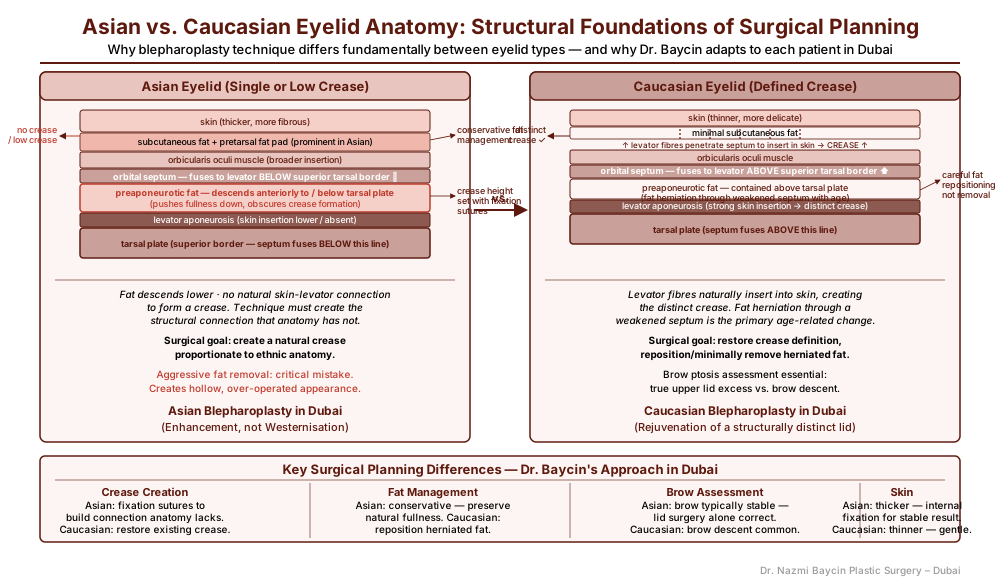
Asian versus Caucasian upper eyelid anatomy — in the Caucasian lid the levator inserts into the skin above the tarsal border to form a defined crease, while in the Asian lid the septum fuses lower and the preaponeurotic fat descends toward the margin, creating a fuller lid with a low or absent crease — by Dr. Nazmi Baycin, Dubai.
Fat compartment morphology
A common misconception is that a fuller Asian upper lid is simply due to “excess fat.” In reality, the preaponeurotic fat pad is often positioned more inferiorly, and the subcutaneous layer holds more soft tissue. Aggressive fat removal here is a critical mistake I avoid — it can create a hollow, aged, and surgically altered appearance.
My technique focuses on conservative, strategic sculpting, sometimes only releasing and allowing the fat to retract, to maintain the lid’s youthful fullness while refining its contour. In Caucasian eyelids, where fat herniation through a weakened septum is more common, my approach involves careful repositioning or minimal removal to restore a smooth contour without hollowing.
Skin and muscular dynamics
Asian eyelid skin tends to be thicker and more fibrous, while Caucasian skin is often thinner and more delicate. This directly shapes the surgical plan: thicker skin requires precise internal fixation sutures to define a stable crease, whereas thinner skin demands the utmost gentleness to avoid visible irregularities. The orbicularis oculi muscle may also have a broader insertion in Asian eyelids; I preserve its integrity meticulously to maintain the natural strength of the blink and protect ocular surface health — a paramount concern in Dubai’s arid climate.
Asian versus Caucasian blepharoplasty at a glance
The table below sets the two approaches side by side across the anatomical factors that determine the surgical plan.
| Feature | Asian Blepharoplasty | Caucasian Blepharoplasty |
|---|---|---|
| Primary anatomical difference | No levator-skin insertion → no crease | Levator inserts into skin → natural crease |
| Orbital septum fusion level | Below superior tarsal border | Above superior tarsal border |
| Preaponeurotic fat position | Descends to / below tarsal plate | Contained above tarsal plate |
| Fat management | Conservative — preserve natural fullness | Reposition / minimally remove herniated fat |
| Primary goal | Create a proportionate natural crease | Restore and rejuvenate existing crease |
| Skin thickness | Thicker — internal fixation required | Thinner — gentle excision and closure |
| Brow assessment | Typically stable — not a primary concern | Essential — brow ptosis frequently a cause |
| Technique options | Suture method or incision method | Standard incision blepharoplasty |
| Risk of appearing “overdone” | High if crease set too high | High if too much fat / skin removed |
The critical periorbital zone: brow position and lower lid anatomy
The eyelids do not exist in isolation, so I always evaluate the brow-eyelid continuum. In many Caucasian patients, age-related brow descent contributes significantly to upper eyelid heaviness, and a brow lift may be integrated into the plan.
In Asian patients, the brow is often stable and lid fullness is intrinsic; addressing the brow would be anatomically incorrect. This assessment prevents me from mistakenly removing precious eyelid tissue when the true issue lies higher up.
Lower eyelid anatomy also varies — Asian patients often have stronger canthal tendons and different midface support, influencing my approach to lower lid tightening or festoon correction. My priority is always to reinforce the lid’s natural support system to prevent postoperative malposition, a risk heightened by our local environment.
My surgical ethos: enhancement, not westernization
One of the most sensitive aspects of my practice is consulting with Asian patients who desire a defined crease but fear looking “westernized” or artificial. My commitment is clear: I do not westernize Asian eyelids — I enhance them according to their own anatomical logic. Using specialized techniques such as the partial-incision or non-incision methods where appropriate, or a tailored full-incision approach, I create a crease that harmonizes with the patient’s unique orbital bone structure, eye prominence, and skin quality. The result is a natural, refreshed eyelid that belongs unmistakably to them.
The consultation: mapping your unique anatomy
The journey begins with an in-depth consultation where I become a student of your anatomy. Using specialized tools, I assess levator muscle function and strength; the amount and position of orbital fat; skin quality, thickness, and elasticity; brow position and its dynamic interaction with the lid; and the underlying bony orbital structure. We then discuss your functional concerns — heaviness, obscured vision — and aesthetic desires within the framework of what is anatomically prudent and sustainable. This collaborative planning is the bedrock of a successful outcome, and because every plan is individual, its details and cost are discussed transparently at consultation. For a deeper understanding of this process, explore my overview of eyelid surgery in Dubai.
Why experience in a multicultural hub matters
Dubai’s diversity is my greatest teacher. It has given me the experience to understand the full spectrum of eyelid anatomy intimately, and that versatility is crucial — there is no room for a surgeon with a single, rigid technique. My practice is built on the ability to adapt: to appreciate the subtle differences that make each patient unique and to apply the precise technical strategy those differences demand, so that every patient, regardless of background, receives care that is as individually crafted as they are. This identity-preserving philosophy runs through all of my facial cosmetic surgery work in Dubai.
FAQs about Asian and Caucasian eyelid surgery in Dubai
-
What is Asian blepharoplasty and how is it different from regular eyelid surgery?
Asian blepharoplasty — also called double eyelid surgery — creates a supratarsal crease in patients who do not have one, or who have a low or indistinct crease. It differs from standard rejuvenation blepharoplasty because it is not removing excess tissue but creating a structural connection — between the skin and the levator aponeurosis — that is absent in the Asian eyelid anatomy. The technique, the crease height, and the fat management approach are all different from a Caucasian rejuvenation blepharoplasty. I perform both in Dubai, adapting the plan entirely to the individual’s anatomy.
-
Will Asian eyelid surgery make me look Western or artificial?
Only if the crease is set too high or placed without respect for your orbital anatomy. My commitment in every Asian blepharoplasty I perform in Dubai is to create a crease that is proportionate to your specific orbital bone structure, eye prominence, and skin quality — one that looks natural when you are moving and expressing, not only under clinical lighting. The crease height is determined collaboratively, with a clear anatomical rationale for every millimeter of its placement. The goal is enhancement, not transformation.
-
What is the difference between the suture method and incision method for double eyelid surgery?
The suture method places permanent sutures through small puncture points to create the crease without excising skin or fat. It is less invasive and suits patients with thin skin, minimal fat, and no skin excess. The incision method places a controlled incision along the planned crease line, allowing direct access to adjust skin, orbicularis, and fat under vision before placing fixation sutures. It produces a more durable and controllable crease and is preferred for patients with thicker skin or more prominent fat. I select the method based on anatomy assessment at consultation — not by default.
-
Why do Caucasian eyelids develop the hooded or heavy appearance that requires blepharoplasty?
The primary mechanism is a combination of skin laxity and fat herniation. With age, the orbital septum weakens, allowing the preaponeurotic fat pad to herniate forward and downward — pushing against the skin from underneath and contributing to upper lid heaviness. Simultaneously, the skin itself loses elasticity and accumulates in folds above the crease. Additionally, brow descent — the gradual downward migration of the brow — pushes brow tissue onto the upper lid, compounding the appearance of heaviness. I assess all three contributions at every consultation to determine which are the primary drivers and what the correct surgical response is.
-
Can I have blepharoplasty if I have previously had eyelid surgery?
Yes — revision blepharoplasty is possible, though it carries greater technical complexity than primary surgery. Scar tissue from the previous procedure affects tissue planes and mobility. The assessment for revision surgery focuses on the specific deformity from the prior procedure — insufficient or excessive skin removal, crease height that is too high or too low, asymmetry, or functional problems — and builds a corrective plan from that starting point. I perform revision blepharoplasty for patients from Dubai and internationally.
-
How long do blepharoplasty results last?
The results of upper blepharoplasty are long-lasting — typically ten to fifteen years before any further skin laxity or brow descent may warrant consideration of further treatment. The crease created in Asian blepharoplasty with the incision method and internal fixation sutures is permanent: the structural connection created between skin and levator does not dissolve with time. Suture method results are somewhat less permanent and may need reinforcement over years. The natural aging of the skin and periorbital tissues continues regardless of surgery.
-
Is blepharoplasty safe for patients living in Dubai’s climate?
Yes — with specific aftercare attention to ocular surface hydration. Dubai’s arid climate reduces ambient humidity, which can affect tear film stability during the period when the eyelid margin is adjusting post-operatively. I advise all blepharoplasty patients to use preservative-free artificial tear drops regularly during the healing phase — typically four to six weeks — to protect the corneal surface. This simple protocol effectively manages the climate-specific risk and supports comfortable healing.


GET APPOINTMENT
Get ready to look and feel best… You deserve…
