

Key takeaways: the slim-patient tummy tuck
- For slim patients the problem is skin laxity, muscle separation, and lost waist definition — not excess fat.
- With no fat to hide flaws, every millimeter of tissue handling matters, and precision replaces power.
- Graduated muscle plication restores the natural abdominal corset — strongest at the midline, tapering laterally — rather than a rigid, uniform tightening.
- Umbilical refinement re-centers the belly button to skeletal landmarks to avoid the tell-tale signs of surgery.
- Tension is carried by a deep fascial (Scarpa’s) layer, so the skin closes under minimal strain for a fine scar.
- Diastasis repair is functional as well as aesthetic — it can restore genuine core strength.
Why slim patients need a different tummy tuck strategy
In slim patients, the problem is rarely excess volume. Instead, the issues are mild but visible skin laxity, umbilical hooding or distortion, subtle lower-abdominal bulges, early separation of the rectus muscles (diastasis recti), and a flattened or undefined waistline. Because there is limited fat to conceal imperfections, every millimeter of tissue handling matters. Over-resection can create an unnaturally tight, wind-swept appearance that distorts the hips and mons pubis, while under-correction leaves residual laxity that is equally visible on a lean frame.
My strategy is founded on precision rather than power. During marking, I assess not just what to remove, but — more critically — how the remaining skin will redrape under dynamic tension. This prevents the over-tightened look that plagues many patients who undergo a traditional, one-size-fits-all approach.
Graduated muscle plication in a lean abdomen
Many slim patients do not realize that a subtle separation of the abdominal muscles is often the root cause of their shape problems — and that no amount of training will close it once it is established, which I set out in full in my article on why exercise cannot close a true diastasis. What the condition is in its own right, and when it warrants repair at all, I cover in diastasis recti and when it actually needs repair. What concerns me here is narrower: how that repair is tensioned in a patient who has no fat to hide behind. A common technical mistake I correct in my revision practice is the use of a uniform, high-tension plication from the xiphoid to the pubis, which can create an unnaturally rigid, flat abdominal wall that lacks the subtle convexity of a natural torso.
My technique instead uses graduated, anatomical muscle plication: I restore tension strongest at the midline, tapering it gently toward the lateral edges. This reconstructs the natural corset of the abdomen, enhancing the waistline while preserving the soft, flexible transition needed for natural posture and movement. How that repair is engineered to survive intra-abdominal pressure over decades — the layered midline seam, the reinforcement above the navel, and the lateral tensioning that holds the waist from within — is a subject in its own right, which I cover in my article on how a layered repair is engineered to last.
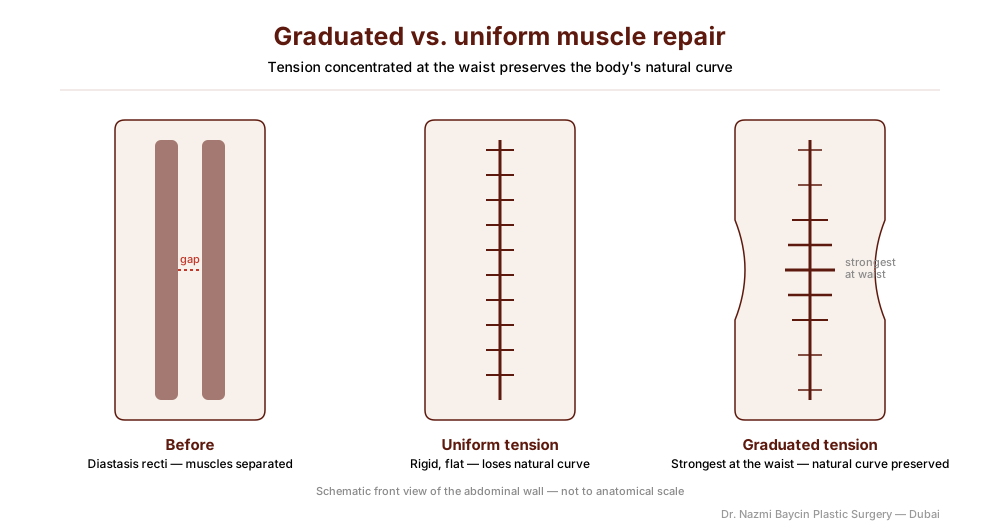
Graduated muscle plication: tension is strongest at the midline and tapers laterally to rebuild the natural abdominal corset and define the waist — unlike a rigid, uniform high-tension repair — by Dr. Nazmi Baycin, Dubai.
Clinical research supports this philosophy. A 2026 prospective single-centre study of 50 women with moderate-to-severe diastasis recti found that abdominoplasty with rectus-sheath plication measurably improved core strength and quality of life, restoring the integrity of the linea alba — evidence that the repair is a biomechanically restorative procedure, not just a cosmetic one.
Durability matters too: a retrospective single-surgeon series of 71 abdominoplasty patients followed for an average of 21 months reported no recurrence of diastasis on examination and a low complication profile, which supports the durability of careful plication in an experienced practice. For a slim patient, where no excess fat exists to mask even minor errors, this functional restoration is inseparable from an exceptional aesthetic result.
Precision umbilical refinement in slim patients
The umbilicus is the focal point of a slim abdomen, and a poorly positioned or reshaped belly button is an immediate tell-tale sign of surgery. My approach goes beyond simple re-circularization. I perform mini-dissected umbilical stalk preservation, carefully freeing it from the surrounding fascia while protecting its neurovascular supply. I then re-center it based on skeletal landmarks — not the old skin position — and use internal, absorbable sutures to anchor it to the underlying repaired fascia, which prevents postoperative migration and hooding. The final shaping involves delicate trimming of the surrounding skin to create a small, vertically oriented aperture with subtle, natural shadows, never a sharp, punched-out look.
Strategic skin redraping without over-tension
The greatest artistry in a slim-patient tummy tuck lies in the skin closure. The mistake of placing all tension on the superficial skin suture line leads to widened scars, distortion, and discomfort. My method is multiplanar tension distribution: after the deep muscle layer is repaired, I re-approximate the superficial fascial system (Scarpa’s fascia) as a separate, strong layer that absorbs the majority of the tension, so the skin itself is then closed with minimal strain. This is what allows the final scar to remain fine and stable rather than stretching over time.
Localized liposculpting for contour harmony
While fat removal is not the goal, absolute contour perfection requires mini-sculpting. Small, stubborn fat deposits often linger in the lower flanks, mons pubis, and periumbilical area, blurring the new definition. I employ feathering liposuction with mini-cannulas in these zones exclusively to blend transitions and sharpen the waistline — not to reduce volume, but to create seamless shadows and highlights.
For patients with denser tissue, I may integrate Vaser liposuction in Dubai for its selective fat-liquefying properties, which allow even more precise sculpting with greater skin-retraction potential in these targeted areas.
Standard versus slim-patient tummy tuck: what differs
| Element | Standard tummy tuck | Slim-patient refinement |
|---|---|---|
| Primary goal | Remove significant excess skin and fat | Refine contour, define the waist, repair muscle — minimal excision |
| Muscle repair | Uniform plication, xiphoid to pubis | Graduated plication: strongest at midline, tapering laterally |
| Margin for error | Some fat masks minor irregularities | None — every millimeter is visible on a lean frame |
| Tension management | Often on the skin suture line | Carried by the deep Scarpa’s fascia layer; skin closed strain-free |
| Fat handling | Volume reduction | Feathering micro-liposuction only, to blend and sharpen |
Who is an ideal candidate for a slim-body tummy tuck in Dubai?
Typical candidates include women after pregnancy with minimal fat but loose skin, patients after mild weight loss, and slender individuals with genetic or age-related muscle laxity. Before surgery, my evaluation is dynamic — I assess you standing, sitting, and during core engagement to understand how your tissue behaves — which allows me to design a plan that delivers a durable, functional, and beautifully aesthetic result tailored to your lifestyle.
This technique is fundamental to achieving a fine-line scar, preserving natural hip curvature, and allowing comfortable movement in all positions. To explore the detailed methodology further, I invite you to visit my dedicated page on tummy tuck in Dubai.
What recovery looks like for a slim-patient tummy tuck
Because the technique relies on precise, layered repair rather than aggressive excision, recovery is usually smoother than patients expect. A supportive garment is worn to reduce swelling and protect the deep repair, and most patients are up and walking gently within a day or two. Discomfort in the first week centers on tightness across the repaired muscle rather than sharp pain, and it is well controlled with medication. Light desk-based work is usually comfortable within one to two weeks, while strenuous core and upper-body activity is deferred for four to six weeks so the plication and fascial closure can consolidate. The waistline continues to sharpen over the following months as residual swelling settles, revealing the defined, natural contour the procedure is designed to create.
Why experience matters more in slim patients
Slim patients offer no margin for error — there is no volume to hide irregularities, so every decision, from incision placement to suture vector, directly influences the final, visible aesthetic. This is why I approach each case as an architectural reconstruction of the abdominal core. A tummy tuck for the slim patient is the pinnacle of abdominal contouring surgery: it requires a surgeon who is not just a technician, but an artist and an engineer of living tissue.
My practice is built on this philosophy, ensuring your result enhances your natural, slender frame with definition, balance, and grace that looks and feels authentically yours. To discuss your goals, I welcome you to consult with me as a leading cosmetic surgeon in Dubai.
FAQs about tummy tuck for slim patients in Dubai
-
Why isn’t a standard tummy tuck approach right for slim patients?
In slim patients, the problem is rarely excess fat — it’s skin laxity, subtle muscle separation, and loss of waistline definition. Because there’s no extra volume to mask imperfections, every millimeter of tissue handling matters. A standard, one-size-fits-all approach risks an over-tightened, wind-swept look or under-corrected residual laxity, both of which are far more visible on a lean frame.
-
What is diastasis recti, and how do you know if I have it?
Diastasis recti is a separation of the abdominal muscles along the midline, and even a small gap can cause loss of waist indentation, lower belly convexity, and core weakness — often without the patient realizing muscle separation is the actual cause. I assess this during a dynamic evaluation, checking how your abdominal wall behaves while standing, sitting, and engaging your core.
-
What’s wrong with a uniform high-tension muscle repair?
A uniform plication from the top to the bottom of the abdomen creates an unnaturally rigid, flat abdominal wall that loses the subtle convexity of a natural torso. My technique uses graduated tension instead — strongest at the midline and tapering toward the lateral edges — which reconstructs the natural corset of the abdomen while preserving flexibility for movement and posture.
-
Will my belly button look natural after surgery?
That’s a primary focus of this technique. I re-center the umbilicus based on skeletal landmarks rather than the old skin position, anchor it internally to the repaired fascia to prevent migration or hooding, and shape the surrounding skin to create a small, naturally shadowed aperture rather than a sharp, punched-out look.
-
Will I have visible fat removed even though I’m already slim?
Fat removal isn’t the primary goal for slim patients, but small, stubborn deposits in the lower flanks, mons pubis, and periumbilical area can blur your new contour. I use feathering liposuction with mini-cannulas in these zones specifically to blend transitions and sharpen the waistline, not to reduce overall volume.
-
How is scar tension managed to avoid a widened scar?
After the deep muscle layer is repaired, I separately re-approximate Scarpa’s fascia as its own strong layer, which absorbs the majority of the tension. This means the skin itself is closed under minimal strain, which is what allows the final scar to remain fine and stable rather than stretching over time.


GET APPOINTMENT
Get ready to look and feel best… You deserve…
